
Table of Contents
Why Understanding the Process Matters
Concrete looks simple once it is poured, but the process that produces a consistent, structurally sound mix involves several tightly sequenced stages, each with its own tolerance for error. Understanding this process matters for two groups of readers: buyers evaluating a plant who want to know what they are actually paying for, and site engineers or quality managers who need to explain deviations when a batch does not perform as expected.
This article walks through how a ready mix concrete plant works from raw material intake to the finished batch, explains where automation changes the outcome, and covers the main process variations you will encounter across different plant types.
 Email Us Today!
Stage One: Raw Material Storage and Handling
The process begins before any weighing happens, with how raw materials are stored and fed into the system. Coarse and fine aggregate sit in separate storage bins or bunkers, typically arranged so that each aggregate type feeds its own weigh hopper through a belt or apron feeder, preventing cross contamination between grades. Cement is stored in a silo, usually fed by a screw conveyor into the weighing hopper on demand rather than sitting exposed, which protects it from moisture that would otherwise compromise its performance.
Water is drawn from an onsite tank or direct supply line through a metered dosing system, and admixtures, which are chemical additives that adjust setting time, workability, or strength development, are stored in small dosing tanks positioned close to the mixer for accurate, minimal delay dosing. How well this stage is designed affects everything downstream, since even accurate weighing cannot correct for aggregate that was contaminated or degraded during storage.
Feeder screens positioned ahead of the weigh hoppers filter out oversized stones and debris before they can enter the batching sequence, which protects both the finished concrete’s grading and the mixer itself from mechanical strain. On plants processing multiple aggregate grades for different mix designs, keeping bins clearly separated and correctly labeled at this stage prevents the kind of cross contamination that is very difficult to catch once materials reach the weigh hopper.
Stage Two: Weighing and Batching
Weighing is the stage that most directly determines whether the finished concrete meets its design specification. Each material, cement, aggregate, water, and admixture, is weighed independently using load cell based hoppers, with the proportions dictated by the mix design stored in the plant’s control system. This is where IS 4925 tolerances apply directly: roughly 2 percent for cement, 3 percent for aggregate, and 1 percent for water and admixture, and staying within these bands consistently is what separates a Class I automatic plant from a manual or semi automatic operation.
Modern plants use quick exhaust valves on the pneumatic weighing cylinders, which release hopper gates rapidly and consistently rather than relying on an operator’s timing, keeping each batch’s weight accurate even as production continues for hours at a stretch. Any drift in weighing accuracy compounds across a shift, which is why periodic calibration, required before commissioning, after relocation, and at regular intervals, remains part of the process rather than a one time setup step.
The sequence in which materials enter the mixer also affects final quality, not just their individual weights. Most mix designs call for aggregate and a portion of the water to enter first, followed by cement, with the remaining water and admixture added once the dry materials have begun combining, a sequence the PLC governs automatically so it stays consistent regardless of which operator is running a given shift.
Stage Three: Mixing
Once materials are weighed, they move into the mixing stage, where the approach differs by plant type. Wet mix plants combine all materials in a twin shaft or pan mixer at the plant itself, producing fully homogeneous concrete before it ever leaves the batching area, which gives tighter, more repeatable quality control. Dry mix plants instead load the weighed materials directly into the transit mixer, which completes the mixing during transport to site, an approach that trades some quality control for lower capital cost and simpler plant layout.
Mixing time and drum rotation speed are calibrated to the mix design, since undermixing leaves the concrete inconsistent while overmixing can affect workability and setting behavior. In plants built around a three batch overlapping cycle, one batch is being weighed while a second is mixing and a third is discharging, which keeps the mixer running near continuously rather than sitting idle between individual batches, lifting real world output closer to the plant’s theoretical maximum.
Stage Four: Discharge and Transport
Once mixing is complete, concrete discharges from the mixer into a waiting transit mixer or directly into a placement point for captive site operations. Discharge timing is coordinated with the dispatch schedule, particularly for commercial RMC operations managing multiple transit mixers across several customer sites in a single shift, where a delay at the plant cascades into delays at every downstream delivery.
From this point, concrete has a limited working window before it begins to set, which is why transport time, traffic conditions, and dispatch sequencing are treated as part of the production process rather than a separate logistics function. Plants located with delivery radius in mind, rather than purely on land cost, tend to perform better on this stage over time.
Stage Five: Automation and Quality Documentation
Running through all four physical stages is the plant’s control system, almost universally PLC based in any serious operation today. The PLC stores multiple mix designs and switches between them in seconds, coordinates the weighing, mixing, and discharge sequence without relying on manual timing at each step, and generates a batch record for every load produced.
This batch record matters beyond internal quality control. Projects executed under NHAI and similar government contracts require documented proof that each batch met its specified tolerances, and a PLC based system produces this documentation automatically rather than requiring manual logs that are easy to falsify or simply forget to complete during a busy shift.
 Call Now!
Process Variations Worth Knowing
Beyond the wet mix and dry mix distinction already covered, buyers researching this process will also encounter central mix and shrink mix terminology, particularly in technical specifications and tenders.
| Process Type | Where Final Mixing Happens | Typical Use Case |
| Central mix (wet mix) | Fully mixed at the plant before dispatch | Structural concrete requiring tight quality control |
| Shrink mix | Partially mixed at plant, finished in transit | Balances quality control with reduced plant mixing time |
| Transit mix (dry mix) | Fully mixed in the transit mixer during transport | Longer haul distances where transit time allows full mixing |
Quality Checks Along the Process
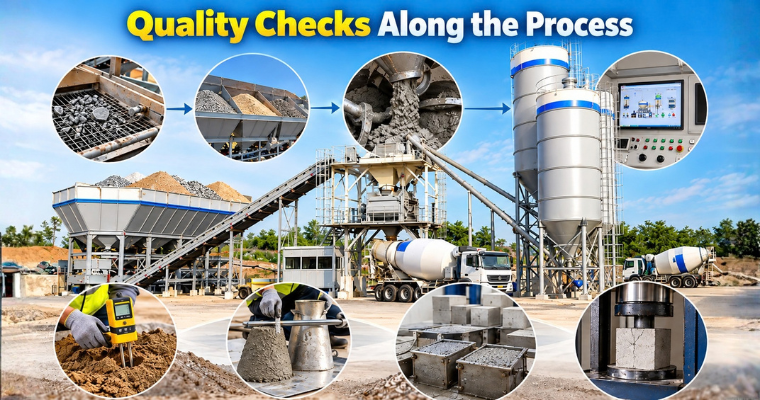
Quality control is not confined to the weighing stage. Aggregate is checked periodically for moisture content, since water already present in aggregate affects the total water added during batching and must be accounted for in the mix design. Slump tests, which measure concrete workability, are typically performed on finished batches before dispatch, and cube samples are cast for compressive strength testing at intervals defined by the project’s quality plan.
Feeder screens ahead of the weigh hoppers catch oversized aggregate before it enters the mix, protecting both concrete quality and the mixer itself from damage. Together, these checks form a quality process that runs alongside, rather than after, production, which is part of why automation and documentation are treated as core to plant design rather than optional add ons.
How Long a Single Batch Cycle Takes
A single batch cycle, from the moment weighing begins to the moment mixed concrete discharges, typically runs between 45 seconds and a little over a minute on a well maintained automatic plant, depending on batch size and mixer type. This figure matters less on its own than it does in combination with the three batch overlapping cycle, since overlapping the weighing of one batch with the mixing of another is what allows a plant to approach its rated hourly output rather than falling well short of it.
Site conditions affect this cycle time in practice. Aggregate moisture that varies through the day, ambient temperature affecting admixture behavior, and operator response time on semi automatic systems can all extend the effective cycle, which is one reason plants with consistent, well calibrated automation tend to hold their rated output more reliably across a full shift than plants that depend heavily on manual intervention.
Common Process Failures and What Causes Them
Most production problems traced back to the batching process itself fall into a small number of recurring categories, and recognizing them early prevents a minor deviation from becoming a rejected batch.
- Inconsistent slump across batches, usually caused by uncorrected aggregate moisture variation rather than a fault in the mix design itself.
- Segregation of aggregate and cement paste, often traced to excessive mixing time or a mixer that is undersized for the batch volume being processed.
- Weighing drift over a shift, typically a sign that load cells or pneumatic valves need calibration rather than a mix design problem.
- Delayed discharge affecting workability on arrival, generally a dispatch scheduling issue rather than a plant performance issue, and one that points back to delivery radius planning covered elsewhere in plant selection.
How Apollo Inffratech’s ATP Series Runs This Process
Apollo Inffratech’s ATP series is built around the three batch overlapping cycle described above, paired with PLC automation that handles mix design storage, weighing sequencing, and batch record generation as a single integrated system rather than separate add on modules. Heavy duty steel construction and MPCB protected motors keep the plant running through extended production shifts, while feeder screens and quick exhaust valves maintain the weighing accuracy the whole process depends on.
For businesses running the full concrete production and placement chain, Apollo Inffratech also manufactures self loading concrete mixers, useful for smaller or harder to reach pours that do not justify dispatching a full transit mixer, and slip form pavers for road and pavement work that follows the concrete supply chain downstream.
Conclusion
A ready mix concrete plant’s output is only as good as the weakest stage in this process, which is why evaluating a plant on capacity alone misses most of what determines its real world performance. Storage design, weighing accuracy, mixer type, and the automation coordinating all three together decide whether a plant consistently meets its mix design specification or drifts out of tolerance as a shift wears on.
Apollo Inffratech’s ATP series is engineered so that each of these stages, from aggregate handling through to batch documentation, works as a coordinated system rather than a set of independent components. Reach out to discuss how the ATP series can be configured for your specific mix design and production schedule.
Frequently Asked Questions
How a Ready Mix Concrete Plant Works: The Complete Process Explained
What are the main stages in the ready mix concrete production process?
The process runs through five linked stages: raw material storage and handling, weighing and batching, mixing, discharge and transport, and quality documentation, all coordinated through the plant's PLC control system.
Why is weighing accuracy so important in concrete batching?
Weighing determines whether the finished concrete matches its design specification. IS 4925 sets tolerances of around 2 percent for cement, 3 percent for aggregate, and 1 percent for water and admixture, and drift outside these bands affects strength, workability, and durability.
What is the difference between wet mix and dry mix in the production process?
Wet mix plants fully mix concrete at the plant before dispatch, giving tighter quality control. Dry mix plants load weighed dry materials into the transit mixer, which completes mixing during transport, suited to projects with longer haul distances.
How does a three batch system change the production process?
A three batch overlapping cycle runs weighing, mixing, and discharge simultaneously across three separate batches rather than completing one stage before starting the next, which keeps the mixer running near continuously and lifts real world output closer to the plant's rated capacity.
What quality checks happen during the production process besides weighing?
Aggregate moisture is checked periodically since it affects total water content, slump tests measure workability on finished batches, and cube samples are cast at intervals for compressive strength testing as defined by the project's quality plan.
Why does the batching process generate a documented batch record?
Government contracts, including NHAI highway projects, require documented proof that each batch met its specified tolerances. A PLC based system generates this record automatically as part of the production process rather than relying on manual logs.
Share At:




Listen to the Audio Version
Table of Contents