
Table of Contents
What Buyers Need to Know Before Comparing Manufacturers
A concrete batching plant is a long term capital investment, typically running for a decade or more once installed, which makes the manufacturer relationship as important as the equipment specification itself. Yet many first time buyers evaluate quotations primarily on rated capacity, comparing one plant’s cubic meters per hour figure against another’s without examining what actually determines whether that plant performs reliably over years of production.
This guide sets out a practical checklist for evaluating a concrete batching plant manufacturer in India, covering the factors that affect real world performance, compliance, and total ownership experience rather than the specification sheet alone.
 Call Now
Why the Manufacturer Matters More Than the Brochure Specs
Two plants can carry an identical rated capacity on paper and still perform very differently once installed. The difference usually comes down to build quality behind the numbers: the grade of steel used in the structural frame, the accuracy and durability of the load cells in the weighing system, the type and condition of the mixer, and how well the PLC automation is integrated rather than bolted on as an afterthought.
Because these differences are difficult to assess from a specification sheet alone, buyers benefit from evaluating the manufacturer’s overall manufacturing process, certifications, and existing installations rather than comparing capacity figures in isolation.
Manufacturing Quality: What to Verify
Structural quality starts with the frame and housing. Look for square and rectangular tubing construction, which resists corrosion and structural fatigue better than lighter gauge alternatives, along with dust and water resistant motor covers that protect electrical components on an active construction site. Motor Protection Circuit Breakers, commonly abbreviated MPCB, should be standard across all motors rather than fitted only to the primary drive, since a single unprotected motor failure can take an entire plant offline during production.
Ask specifically about the weighing system’s load cell brand and calibration process, the mixer type, twin shaft or pan mixer for wet mix plants, and whether the plant uses quick exhaust valves on its pneumatic weighing cylinders, a detail that affects how consistently the plant holds its rated weighing tolerance across a full production shift rather than only during a demonstration run.
Compliance and Documentation
IS 4925 sets the accepted classification standard for batching and mixing plants in India, ranking equipment from Class I, fully automatic, down to Class IV, manual operation, alongside weighing tolerances of around 2 percent for cement, 3 percent for aggregate, and 1 percent for water and admixture. Government contracts, including NHAI highway projects, typically require Class I or Class II plants with documented batch records, which makes PLC based automation a practical necessity rather than a premium upgrade for any buyer targeting this segment of work.
Before finalizing a purchase, confirm the plant’s IS 4925 classification in writing, ask what calibration documentation is provided at commissioning, and clarify how ongoing calibration, required periodically and after any relocation, is supported once the plant is in operation.
After Sales Support: The Criteria Buyers Overlook
A plant’s manufacturing quality determines how well it performs on day one. After sales support determines how well it performs in year five. Annual maintenance contract coverage, spare parts availability without long lead times, and a service network that can reach your site within a reasonable window all affect uptime more directly than most buyers anticipate during the evaluation stage, when attention naturally focuses on the equipment itself rather than what happens after installation.
Ask a prospective manufacturer how many service locations they operate nationally, what their typical response time looks like for a breakdown, and whether critical spare parts, load cells, valves, and motor components, are stocked domestically or require import lead times that could leave a plant idle for weeks during a production commitment.
Product Range and Scalability
A manufacturer offering only a narrow capacity band forces buyers to switch vendors entirely as their business grows, losing the benefit of an established service relationship at the exact point it matters most. A manufacturer covering both compact and inline configurations across a wide capacity range allows a buyer to scale from a small RMC operation into a large infrastructure supplier while keeping the same manufacturer relationship, spare parts pipeline, and service history intact.
This matters more than it first appears, since a growing RMC business rarely predicts its exact future capacity needs at the outset. A manufacturer whose product line spans a wide range, from a 25 cubic meter per hour compact unit through to a 120 cubic meter per hour inline plant, gives a buyer room to add capacity or upgrade configuration later using equipment and support they already understand, rather than starting a new evaluation process from scratch every time demand grows.
How Automation Level Affects Long Term Value
Automation level is easy to treat as a checkbox during evaluation, fully automatic versus semi automatic, without considering how that distinction plays out over years of operation. A fully automatic, PLC governed plant maintains its weighing tolerance and mix design accuracy consistently regardless of which operator is on shift, while a semi automatic plant depends more heavily on individual operator skill and attentiveness, which naturally varies across a workforce and across a long shift.
This consistency compounds over time. A plant that holds tight tolerances from day one through year ten produces a more uniform quality record, which matters directly for RMC operators managing customer relationships and for contractors documenting compliance on government projects, where batch records are reviewed well after the concrete itself has been poured and inspected.
Red Flags to Watch For
Certain patterns during the evaluation stage tend to predict problems later, and recognizing them early saves a buyer from a costly correction after installation.
- Vague or evasive answers about IS 4925 classification, or an unwillingness to put the plant’s rating in writing before the sale.
- No documented list of existing installations or reference sites the buyer can independently verify or contact.
- Pricing that sits significantly below the rest of the market with no clear explanation, which often points to reduced steel gauge, lower grade load cells, or a scaled back automation package.
- Service and support described only in general terms, without specific service locations, response time commitments, or spare parts stocking details.
- Pressure to finalize a purchase quickly without time to verify certifications or speak with existing customers running a comparable plant.
How to Verify Manufacturer Claims Before Buying
Specification sheets and sales conversations are a starting point, not a substitute for independent verification. Requesting a site visit to an existing installation, ideally one running a similar capacity and configuration to what you are considering, lets you observe weighing consistency, noise levels, and general build quality under real production conditions rather than a controlled demonstration.
Asking for the manufacturing facility’s ISO certification documentation, and where possible visiting the facility itself, provides insight into the quality control processes applied to steel fabrication, welding, and component sourcing before a plant ever reaches a customer site. Buyers who skip this step are relying entirely on the manufacturer’s own claims, which is a reasonable risk for a low value purchase but less so for equipment representing a capital investment measured in years of production.
Evaluating Local Versus National Manufacturers
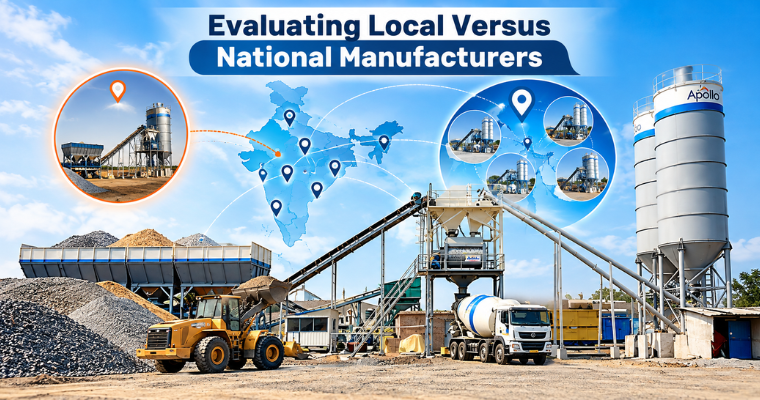
Buyers sometimes assume a locally based manufacturer offers faster service purely by virtue of proximity, but this only holds true if that manufacturer has actually invested in a service network rather than operating from a single facility. A manufacturer with multiple service locations across states, even if headquartered elsewhere, can often respond faster than a purely local operation without dedicated field service staff.
The more reliable question is not where the manufacturer is based, but how many service points they operate relative to where your project sites are located, and what their documented response time has been for buyers in your region specifically.
Evaluation Checklist at a Glance
| Criteria | What to Ask | Why It Matters |
| Manufacturing quality | Steel grade, load cell brand, mixer type | Determines consistency and lifespan under continuous production |
| IS 4925 classification | Class rating and calibration documentation | Required for government contracts and structural concrete work |
| After sales support | AMC coverage, service locations, response time | Directly affects plant uptime over its operating life |
| Spare parts availability | Domestic stock versus import lead time | Determines how quickly a breakdown can be resolved |
| Product range | Capacity bands and configurations offered | Allows the same manufacturer relationship to scale with your business |
Questions to Ask Before Signing a Purchase Order
- What is the plant’s IS 4925 classification, and can that be confirmed in writing before commissioning?
- What annual maintenance contract options are available, and what do they cover beyond routine servicing?
- How many service locations does the manufacturer operate, and what is the typical response time for a breakdown at my site?
- Which spare parts are stocked domestically, and what is the lead time for components that are not?
- Can the manufacturer provide references from buyers running a similar capacity plant for a comparable duration?
How Apollo Inffratech Meets These Criteria
Apollo Inffratech manufactures the full ATP range of concrete batching plants at an ISO certified facility in Mehsana, Gujarat, built around heavy duty steel construction, PLC automation, and weighing systems designed to hold IS 4925 Class I tolerances through sustained production. The company backs this with nationwide installation support, annual maintenance contracts, calibration assistance, and spare parts availability, addressing the after sales factors that most affect a plant’s long term reliability.
Buyers evaluating a full concrete production setup can also source self loading concrete mixers and slip form pavers from the same manufacturer, consolidating equipment sourcing and service relationships across a broader part of the construction workflow rather than managing multiple vendor contracts.
Conclusion
Selecting a concrete batching plant manufacturer is a decision that plays out over a decade or more of operation, not just the installation month. Weighing accuracy, IS 4925 compliance, after sales support, and product range scalability determine whether that decade goes smoothly or involves repeated downtime and vendor switching. Working through the checklist above before requesting final quotations puts a buyer in a stronger position to compare manufacturers on substance rather than headline capacity figures alone, and a manufacturer confident in their build quality and support structure will generally welcome this level of scrutiny rather than resist it.
Apollo Inffratech’s ATP series and the support structure behind it are built specifically to hold up against this kind of evaluation. Reach out with your project’s capacity and compliance requirements to discuss the right configuration.
Frequently Asked Questions
How to Choose a Concrete Batching Plant Manufacturer in India: A Buyer’s Checklist
What should I check first when evaluating a concrete batching plant manufacturer?
Start with manufacturing quality, specifically the structural steel grade, load cell brand, and mixer type, since these determine how consistently the plant performs over years of production rather than just during a demonstration.
Is IS 4925 certification something a manufacturer provides, or something I need to verify separately?
A reputable manufacturer will confirm the plant's IS 4925 classification and provide calibration documentation at commissioning. It is worth requesting this in writing before finalizing a purchase order rather than assuming it by default.
How important is after sales support compared to the initial plant specification?
Very important. A plant with strong initial specifications but weak after sales support can still suffer significant downtime if spare parts or service response are slow, which affects total production output over the plant's operating life.
Should I choose a manufacturer that only makes one type of batching plant?
A manufacturer offering both compact and inline configurations across a range of capacities allows your business to scale without switching vendors, preserving the service relationship and spare parts pipeline you have already built.
What is the difference between a manufacturer and a supplier in this context?
A manufacturer builds the plant, controlling quality at the source and typically offering direct after sales support. A supplier may source from various manufacturers and resell, which can complicate warranty claims and service response if issues arise.
Does Apollo Inffratech provide installation and calibration support after purchase?
Yes, Apollo Inffratech provides nationwide installation assistance, annual maintenance contracts, and calibration support for its ATP series, alongside domestic spare parts availability.
Share At:




Listen to the Audio Version
Table of Contents