
Table of Contents
Concrete Batching Plant Evolution in Indonesia
Indonesia, with its rapid urbanization and expanding infrastructure needs, has become one of the leading economies in Southeast Asia. The construction industry in Indonesia has seen substantial growth, driven by increasing demands for residential, commercial and industrial buildings. Concrete, as one of the most critical materials in construction, has played a vital role in this transformation. The country’s concrete batching plants, which produce ready-mix concrete by combining raw materials, have evolved significantly over time. This article focuses on the development of concrete batching plants in Indonesia, highlighting how they have shifted from traditional methods to modern techniques and the role of concrete equipment in cities such as Jakarta, Surabaya and Bali.
 Email Now!
From Traditional Concrete Mixing to Advanced Concrete Solutions in Indonesia
In the early years of Indonesia’s development, particularly in cities like Jakarta and Surabaya, concrete was often mixed manually or with basic machines. Builders would rely on local labor and portable concrete mixers to prepare the concrete mixture on-site. This method, while effective for small-scale projects, had its limitations. Mixing concrete manually often resulted in inconsistent quality, which was particularly problematic for larger, more complex construction projects such as high-rise buildings or large industrial complexes.
However, as demand for larger and more reliable construction projects grew, the limitations of manual mixing became increasingly apparent. To meet the demand for higher-quality concrete, contractors and builders in major cities began investing in modern concrete batching plants. These plants, capable of mixing precise amounts of cement, aggregates and water, allowed for more uniform and durable concrete – critical for meeting the construction needs of expanding urban centers like Jakarta, Surabaya and Makassar.
Jakarta: The Heart of Indonesia’s Concrete Revolution
As Indonesia’s capital and largest city, Jakarta has always been at the forefront of infrastructure development. The city’s rapid urbanization and growing demand for residential and commercial space have spurred significant advancements in concrete production. In the early days, the city’s construction industry relied on traditional methods of concrete mixing, but as Jakarta became a major urban hub, the need for advanced concrete solutions became evident.
Concrete batching plants in Jakarta began to adopt more automated systems, ensuring precise mixing and reducing labor costs. The introduction of ready-mix concrete, which is pre-mixed and transported to construction sites, played a key role in Jakarta’s construction boom. The use of ready-mix concrete allowed for faster, more efficient construction, reducing the time needed to complete large-scale projects. Furthermore, ready-mix concrete pumps, which allowed concrete to be delivered directly to high-rise buildings or other hard-to-reach locations, significantly improved the efficiency of construction projects across Jakarta.
Today, the city’s concrete batching plants are equipped with state-of-the-art concrete mixers and automated systems ensure that the quality of concrete meets the strictest standards. Companies have also turned to self-loading mixers, which are highly versatile, capable of transporting, loading and mixing concrete all in one go – streamlining the process further in the city’s bustling construction sites.
Our Other Product
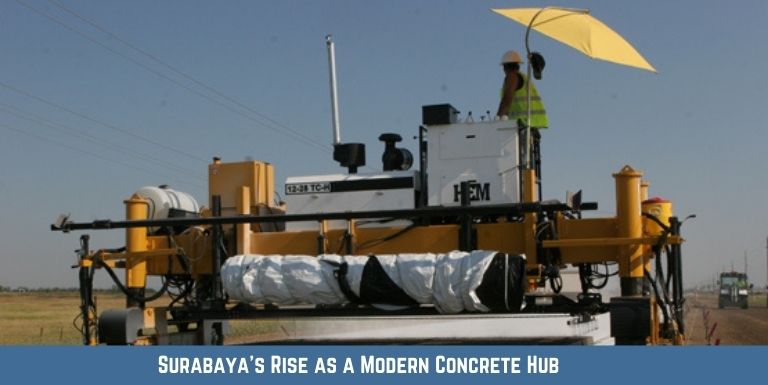
Slip Form Concrete Road PaverSurabaya: A Growing Hub for Concrete Solutions
Surabaya, Indonesia’s second-largest city, has also seen significant growth in construction and infrastructure over the past few decades. As a major port city in East Java, Surabaya’s construction needs are both diverse and demanding. In the early years, the city’s concrete was mixed in a more traditional manner, with smaller concrete mixers used for residential projects and manual labor for larger developments.
However, the increased demand for infrastructure projects such as bridges, ports and commercial buildings prompted a shift toward more modern concrete production methods. The introduction of automated batching plants in Surabaya allowed for greater precision in concrete mixing and faster production times. Concrete mixer manufacturers began to introduce more advanced models to meet the needs of the local construction industry, including large-scale batch plants and highly efficient concrete mixing equipment.
Self-loading concrete mixers have become increasingly popular in Surabaya, particularly for projects in urban areas where access is limited. These machines are highly mobile and can mix and transport concrete to remote or difficult-to-reach construction sites without requiring additional equipment. In Surabaya, where urban development is expanding rapidly, self-loading mixers play a critical role in reducing delivery times and improving overall construction efficiency.
Testimonials
“We have purchased concrete plant & transit mixer from Apollo Inffratech and the working performance of machines are quite satisfactory.”
Bali: Adapting Concrete Technology for Tourism and Residential Developments
Bali, known for its thriving tourism industry, has seen a rise in construction projects, particularly in the hospitality and residential sectors. As an island with a unique landscape, including remote and coastal areas, the demand for innovative concrete solutions is growing. Traditional concrete mixing methods, while suitable for some projects, were not efficient enough to meet the growing needs of Bali’s fast-developing tourism sector.
The introduction of ready-mix concrete has proven to be a game-changer in Bali’s construction landscape. Ready-mix concrete plants, equipped with advanced concrete mixing equipment, are now regularly used for large hotel complexes, resorts and luxury villas, which are in high demand across the island. Additionally, the use of concrete pumps has become increasingly common in these developments, allowing concrete to be delivered directly to elevated structures or through narrow pathways.
Bali’s construction industry has also embraced self-loading concrete mixers. These machines are ideal for the island’s diverse terrain, where accessibility to construction sites can be challenging. The self-loading concrete mixers provide flexibility, as they can be used for both small residential projects and large-scale developments. Their ability to efficiently mix and transport concrete has allowed Bali’s construction industry to keep up with the growing demand for infrastructure, while maintaining high standards of quality and efficiency.
Concrete Mixing Equipment: Key to Efficient Construction Practices Across Indonesia
Across Indonesian cities, concrete mixing equipment has played an essential role in modernizing construction practices. As demand for ready-mix concrete has surged, the use of specialized concrete mixing equipment, such as self-loading concrete mixers and automated batching plants, has become commonplace.
The integration of automated systems in concrete batching plants has brought about numerous benefits, particularly in terms of efficiency and quality control. Concrete mixing plants in cities like Jakarta, Surabaya and Bali are increasingly adopting technologies that allow for real-time monitoring and adjustment of the mixing process. These systems help ensure the correct mix proportions, reducing waste and improving the quality of the final product. In the construction of high-rise buildings, bridges and other critical infrastructure, consistency and durability of the concrete are paramount, making the use of advanced concrete mixing equipment indispensable.
Additionally, as the demand for more sustainable construction solutions grows, concrete manufacturers in Indonesia are beginning to explore eco-friendly alternatives, such as incorporating recycled aggregates or reducing the carbon footprint of concrete production. These innovations are not only helping the construction industry meet regulatory standards but also contributing to the country’s long-term environmental goals.
 Call Now!
The Future of Concrete Batching Plants in Indonesia
Looking ahead, the future of concrete batching plants in Indonesia seems poised for even greater advancements. With continued urbanization and increasing infrastructure needs in cities like Jakarta, Surabaya and Bali, the demand for high-quality, efficiently produced concrete will only continue to rise. The integration of digital technology, artificial intelligence and IoT (Internet of Things) is likely to become more prevalent, enabling even more precise control over the concrete mixing process.
Self-loading mixers and ready-mix concrete pumps will also continue to play a pivotal role in the construction process, particularly in urban areas where space is limited and construction sites are difficult to access. As Indonesian cities grow, the need for more versatile and efficient concrete solutions will drive further innovation.
Moreover, there is likely to be a push toward greater sustainability in the concrete production process. As environmental concerns become more pressing, the development of green concrete solutions – such as low-carbon concrete or alternatives to traditional cement – will likely become a focus for both manufacturers and construction companies.
Conclusion
In conclusion, the evolution of concrete batching plants in Indonesia has been shaped by the growing demands of its rapidly developing cities. From the early reliance on manual mixing methods to the introduction of sophisticated automated systems and ready-mix concrete, the country’s construction industry has made tremendous strides. Cities like Jakarta, Surabaya and Bali have embraced these technological advancements to meet the needs of their expanding urban environments. As Indonesia continues to grow, the future of concrete production will be defined by even greater automation, sustainability and efficiency. With the rise of self-loading concrete mixers and the increasing use of ready-mix concrete pumps, the construction sector in Indonesia is well-positioned to tackle the challenges of the future, ensuring the continued growth and modernization of its cities and infrastructure.
Table of Contents