
Table of Contents
Three Terms, Three Different Deployment Answers
Buyers researching concrete batching plants quickly run into three configuration terms used almost interchangeably in casual conversation: mobile, stationary, and portable. While the underlying batching and mixing technology is similar across all three, the physical configuration each one uses solves a different problem, and choosing based on target output alone, without considering how the plant needs to be deployed, is one of the more common mistakes buyers make.
This article defines each configuration clearly, explains when each one makes practical sense, and gives a decision framework for matching your project’s actual site conditions and timeline to the right choice. It also covers a few misconceptions that commonly lead buyers toward a configuration that meets their capacity target on paper but does not actually suit how the plant will be deployed on site.
 Call Now!
Defining the Three Configurations
A stationary or inline plant is built as a fixed installation, typically requiring a concrete foundation and a more involved civil setup before production can begin. In exchange for this upfront work, inline plants deliver the highest sustained output and are engineered for continuous, long duration production, commonly using a three batch overlapping cycle to keep the mixer running near continuously.
A portable, more commonly called compact, plant is engineered specifically to avoid foundation work altogether. Built on square and rectangular tubing for structural rigidity without a poured foundation, a compact plant can be erected and brought into production within a fraction of the time an inline installation requires, at the cost of somewhat lower maximum output.
A mobile plant takes portability a step further by mounting the batching system on a chassis or skid designed for repeated relocation, often between multiple project sites over the course of a year rather than settling at one location for an extended period. Mobility here refers specifically to how easily and how often the plant physically moves, which is a different concern from how much site preparation it needs at any single location.
Key Differences at a Glance
| Factor | Stationary (Inline) | Portable (Compact) | Mobile |
| Foundation required | Yes | No | No |
| Typical erection time | Longest, foundation dependent | Fast, days rather than weeks | Fastest, designed for repeat relocation |
| Sustained output | Highest | Moderate to high | Moderate, depending on model |
| Best project duration | Long term, ongoing operation | Medium term, single project | Short term, multiple sites |
| Site footprint | Largest | Small | Small, chassis mounted |
When a Stationary Plant Makes Sense
A stationary inline plant is the right choice when a business expects sustained, high volume production from a single location over a long period, whether that is a commercial RMC operation serving multiple customers or a multi year infrastructure project such as a highway corridor or metro rail segment. The foundation and civil work required upfront pays off through higher sustained capacity and generally lower long term wear compared to a lighter, non foundation mounted structure running at similar output for years.
Because relocating a stationary plant is a significant undertaking, this configuration works best when there is reasonable confidence the site will remain the operation’s base for the foreseeable future, rather than for a project with a defined, shorter end date.
When a Portable (Compact) Plant Makes Sense
A compact plant fits situations where fast deployment and a small footprint matter more than maximum possible output. This includes urban sites with limited available space, single project engagements running a year or two where foundation work would not be justified, and businesses entering RMC or captive concrete production for the first time and preferring a lower complexity starting point before scaling into a larger inline installation.
Compact plants also suit buyers who want the option to relocate the plant once a project concludes, even though they are not designed for the frequent, repeated moves a mobile plant handles. A compact plant can be dismantled and moved to a new site between projects without the sunk cost of abandoning foundation work behind.
When a Mobile Plant Makes Sense
A mobile plant is the right fit when a business operates across multiple, often shorter duration project sites within a year, such as a contractor moving between several smaller road or building projects across a region rather than committing to one large, extended engagement. The chassis or skid mounted design minimizes the time and cost associated with each relocation, which matters when a business’s revenue depends on keeping downtime between sites as short as possible.
Mobile plants generally trade some maximum capacity for this relocation speed, which is a reasonable tradeoff for a business whose project pipeline consists of multiple, geographically spread engagements rather than one large, fixed location operation.
Common Misconceptions About These Configurations
A few assumptions consistently trip up first time buyers evaluating these three configurations, and clearing them up early prevents a specification mismatch later in the buying process.
- Assuming mobile always means lower capacity than stationary. In practice the gap has narrowed considerably as compact and mobile designs have improved, though inline plants still generally lead at the very top of the capacity range.
- Assuming portable and mobile are simply two names for the same thing. Portability is about footprint and foundation avoidance at one site, while mobility is specifically about how easily the plant physically relocates between sites.
- Assuming a compact plant is a permanent compromise rather than a legitimate long term choice. Many established RMC operators run compact plants indefinitely because the configuration continues to suit their site and operational needs even after the business has matured.
- Assuming foundation work is only a cost consideration. It is also a time consideration, since foundation curing and civil work can add weeks to a project timeline before an inline plant can begin production.
 Email Us Today!
Installation and Commissioning Differences
The practical experience of bringing each configuration into production differs meaningfully, and this is often underweighted during the evaluation stage in favor of comparing capacity figures. An inline plant’s installation timeline is generally driven by civil work, foundation curing, and structural assembly, which together can extend commissioning well beyond what the batching equipment itself would require if foundation work were not a factor.
Compact plants, built specifically to skip this step, typically reach production readiness in a fraction of that time, since structural assembly on a pre engineered frame replaces foundation dependent construction. Mobile plants compress this further still, since the chassis mounted design is built around rapid setup and breakdown as a core requirement rather than a secondary benefit, which matters directly to a business whose revenue depends on minimizing idle time between site moves.
A Decision Framework for Choosing Between the Three
- If the plant will serve one location for multiple years with high, sustained output requirements, choose a stationary inline plant.
- If the project is medium term, space is limited, or you want to avoid foundation work while still getting strong output, choose a compact plant.
- If your business model involves moving between multiple shorter duration sites within a year, choose a mobile plant.
- If you are uncertain how long the current site will remain active, a compact plant generally offers the safest middle ground, since it avoids the foundation commitment of an inline plant while still delivering meaningful output.
Maintenance Considerations by Configuration
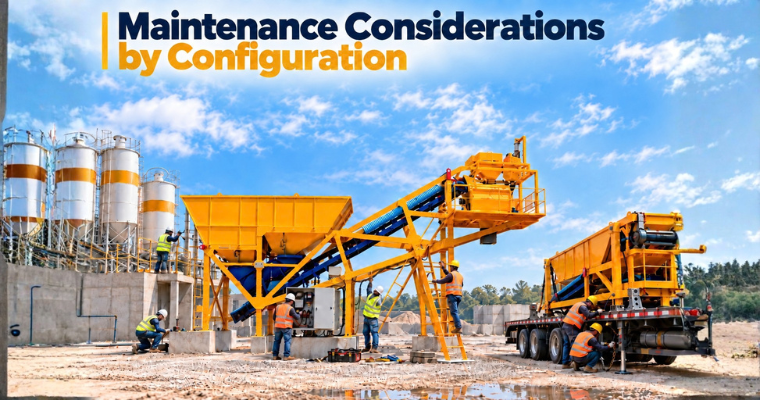
Maintenance patterns differ somewhat across the three configurations, largely as a function of how often the plant moves and how it is anchored. Stationary plants, once installed, tend to develop a stable, predictable maintenance rhythm since components are not subjected to the vibration and stress of repeated transport and reassembly. Compact plants, while not relocated as often as mobile units, still see periodic dismantling and reassembly across their operating life, which makes connection points, cabling, and structural joints worth inspecting more closely at each setup.
Mobile plants see the most frequent assembly cycles by design, which places a premium on components built specifically for repeated setup and breakdown rather than a stationary unit’s components adapted for occasional relocation. Buyers evaluating a mobile plant should ask specifically how the manufacturer has engineered for this repeated cycle, since a plant not designed for it can develop wear issues considerably faster than its rated service life would suggest.
Why This Choice Matters More Than Headline Capacity
Buyers frequently compare plants primarily on rated output in cubic meters per hour, but a plant that cannot be deployed in a way that matches the project’s actual timeline and site conditions will underperform its rated capacity regardless of the number on the specification sheet. An inline plant capable of high sustained output delivers little value if foundation work delays the start of production past when it was actually needed, just as a mobile plant chosen for a long term, single site operation may involve unnecessary tradeoffs in maximum output.
Matching configuration to deployment pattern first, and then selecting the specific capacity within that configuration, tends to produce a better outcome than starting from a target output figure alone.
Apollo Inffratech’s Range Across Configurations
Apollo Inffratech manufactures both inline and compact configurations within its ATP series, spanning 25 to 120 cubic meters per hour, so buyers can select based on deployment needs first without being forced into a capacity band that does not match their actual project. Inline models are built for sustained infrastructure and commercial RMC production, while compact models serve buyers who need fast deployment, a smaller footprint, or a lower complexity entry point into concrete production.
For businesses that also need equipment for pavement work or smaller, harder to reach pours, Apollo Inffratech’s slip form pavers and self loading concrete mixers round out the equipment lineup available from the same manufacturer relationship.
Conclusion
Mobile, stationary, and portable batching plants solve genuinely different deployment problems, even though all three can be specified with broadly similar output ranges. The right choice starts with an honest assessment of how long the plant will operate at a given site and how much site preparation time the project can absorb, rather than starting from a target capacity figure alone. Buyers who work through this deployment question first, before comparing capacity figures across brands, generally end up with a plant that performs closer to its rated output in practice.
Apollo Inffratech’s ATP series covers both inline and compact configurations, giving buyers a path to match plant deployment to their actual project timeline. Reach out to discuss your site conditions and production requirements.
Frequently Asked Questions
Mobile vs Stationary vs Portable Concrete Batching Plant: Which One Fits Your Project
What is the main difference between a mobile and a portable concrete batching plant?
A portable, or compact, plant is designed to avoid foundation work and minimize footprint at a single site. A mobile plant goes further, mounting the batching system on a chassis specifically built for frequent relocation between multiple project sites.
Does a stationary plant always produce more concrete per hour than a compact plant?
Not always, since output depends on the specific model, but inline plants are generally engineered for the highest sustained volume, particularly using a three batch overlapping cycle, making them the typical choice for continuous, high demand operations.
Can a compact plant be relocated once a project is finished?
Yes, a compact plant can be dismantled and moved to a new site, though it is not built for the frequent, repeated relocation a mobile plant handles. It suits occasional relocation between medium term projects rather than continuous movement.
How do I decide between a stationary and a compact plant for a two year project?
A two year project sits in a middle ground where either could work. If the site will remain the operation's base afterward, a stationary plant may be worth the foundation investment. If the site is temporary or space constrained, a compact plant generally offers a better fit.
Are mobile plants suitable for high capacity infrastructure projects?
Mobile plants generally trade some maximum output for relocation speed, making them better suited to multiple, shorter duration sites rather than a single large infrastructure project requiring sustained, high volume production from one location.
Does Apollo Inffratech manufacture both stationary and compact batching plants?
Yes, Apollo Inffratech's ATP series includes both inline (stationary) and compact configurations across a 25 to 120 cubic meter per hour capacity range, allowing buyers to choose based on deployment needs and project duration.
Share At:




Listen to the Audio Version
Table of Contents