
Table of Contents
Why Location Matters When Choosing an RMC Plant Manufacturer
Gujarat has become one of India’s most active construction markets, driven by highway expansion, industrial corridor development, and steady urban growth in cities like Ahmedabad, Surat, and Vadodara. This activity has created consistent demand for concrete equipment, and for businesses evaluating an RMC plant or concrete batching plant, sourcing from a manufacturer based within the state carries practical advantages that go beyond simple convenience.
This article covers what buyers in Ahmedabad and across Gujarat should know about sourcing an RMC plant locally, the project types driving current demand, and how to match plant configuration to the kind of site conditions common across the region.
 Call Us Now!
Gujarat’s Construction and Infrastructure Landscape
Gujarat’s infrastructure pipeline spans several categories relevant to concrete equipment buyers: national and state highway projects connecting the state’s industrial belts, metro rail expansion in Ahmedabad, ongoing smart city and urban infrastructure programs, and a steady stream of industrial and warehousing construction supporting the state’s manufacturing base. Each of these project categories places different demands on concrete supply, from continuous high volume output on highway stretches to smaller, tightly scheduled pours on urban commercial developments.
This variety is part of why the region supports both commercial RMC suppliers, who serve multiple builders across a city or district, and contractors running captive batching plants dedicated to a single large project for its duration. As individual project timelines shift, the same construction company in Gujarat often moves between these two models over time, starting with a captive plant on a single contract before expanding into commercial supply once the business and customer base justify it.
Why Sourcing Locally Matters for a Batching Plant Purchase
A concrete batching plant is heavy, specialized equipment, and both its initial delivery and its ongoing support benefit from proximity between manufacturer and buyer. Shorter transport distances reduce delivery timelines and the logistics complexity of moving structural components, silos, and control systems to site. Installation teams based within the same state can typically reach a project faster than one traveling from another region, which shortens the gap between delivery and the plant becoming operational.
Ongoing support follows the same logic. Calibration, required periodically under IS 4925 and after any relocation, and routine maintenance both benefit from a service team that does not need to travel long distances for a routine visit, and a manufacturer with local presence tends to have a better working familiarity with regional factors such as typical aggregate sources, water quality, and common site layouts.
How Gujarat’s Highway and Industrial Corridor Growth Is Shaping Demand
Gujarat sits along several major national highway corridors and industrial freight routes, and ongoing widening, upgrade, and new corridor construction along these routes has become a consistent source of demand for high capacity batching plants over the past several years. Contractors executing these stretches typically work under NHAI specifications requiring Class I automatic plants with documented batch records, which shapes the kind of equipment specified for this segment of work regardless of which manufacturer ultimately supplies it.
Alongside highway work, Gujarat’s industrial base, spanning textiles around Surat, petrochemicals around Vadodara, and diversified manufacturing across the Ahmedabad Mehsana belt, continues to generate warehousing, factory, and allied infrastructure construction. This industrial construction tends to run on shorter, more defined timelines than highway work, which is part of why compact and mobile batching plant configurations see steady demand in these project categories.
Site Considerations Specific to Ahmedabad and Gujarat
A few regional factors consistently influence plant selection for buyers across Gujarat beyond the general project type. Urban land cost and availability in central Ahmedabad make a compact plant’s smaller footprint genuinely valuable rather than a nice to have, since securing space for a full inline installation with foundation work can be difficult or expensive in already built up areas.
Monsoon timing is another practical factor local buyers plan around, since site access and material storage conditions change materially during Gujarat’s monsoon months, which affects both installation scheduling for a new plant and covered storage planning for cement and admixture at an operating site. Power supply reliability at the chosen site should also be confirmed early, since batching plant automation and weighing systems depend on stable electrical supply to hold their rated accuracy consistently.
Apollo Inffratech’s Mehsana Manufacturing Facility
Apollo Inffratech manufactures its complete ATP range of concrete batching plants at an ISO certified facility in Mehsana, Gujarat, placing the company’s manufacturing, installation, and service operations within reach of projects across Ahmedabad and the surrounding districts. This regional base supports faster delivery to sites across the state and puts calibration and after sales service closer to where plants are actually operating, rather than routing every service request through a distant regional office.
For buyers across Gujarat, this also means installation and commissioning support comes from a team with direct, repeated exposure to the state’s construction environment, rather than a generalized national service structure with limited regional depth.
Serving Ahmedabad’s Urban and Infrastructure Projects
Ahmedabad’s construction activity spans dense urban redevelopment, metro rail corridor work, and industrial development on the city’s outskirts, each presenting different site constraints. Urban commercial and residential sites in established parts of the city often have limited space for equipment, which is where compact batching plants, needing no separate foundation and offering a smaller footprint, tend to fit better than a larger stationary inline unit.
Highway and metro corridor work, by contrast, typically demands sustained, high volume output over an extended construction period, making an inline plant with three batch cycle efficiency the more practical choice despite its larger footprint and foundation requirement. Ahmedabad’s ongoing metro rail expansion in particular has required plants capable of sustaining output across multiple elevated corridor sections simultaneously, a demand profile that favors higher capacity inline configurations over compact alternatives.
Peripheral industrial zones around Ahmedabad, where warehousing and factory construction continues at a steady pace, tend to sit in between these two extremes, often favoring a mid range compact or inline plant depending on the specific project’s duration and whether the site will supply a single facility or serve as a base for multiple nearby developments.
 Email Now!
Local Calibration and Compliance Support
IS 4925 requires periodic calibration of batching plant weighing systems, along with recalibration after any relocation, and this requirement does not pause simply because a plant is running continuously to meet a project deadline. For commercial RMC operators and contractors working under NHAI or similar government specifications, calibration documentation forms part of the quality record reviewed alongside the concrete itself, making scheduling reliability as important as the calibration procedure.
A manufacturer based within Gujarat can generally schedule these calibration visits with less lead time and less disruption to ongoing production than one dispatching a technician from another state, which matters most during periods of sustained high output on highway or metro corridor work where any plant downtime carries a direct knock on effect for the project schedule.
Matching Plant Configuration to Gujarat’s Project Types
| Project Type | Common in Gujarat | Typical ATP Configuration |
| Urban residential and commercial | Ahmedabad, Surat, Vadodara city projects | Compact (ATP 25 to 45) |
| Highway and expressway construction | State and national highway corridors | Inline (ATP 60 to 120) |
| Metro rail and elevated corridors | Ahmedabad metro expansion | Inline (ATP 75 to 100) |
| Industrial and warehousing construction | Industrial belts across the state | Compact or Inline, depending on project duration |
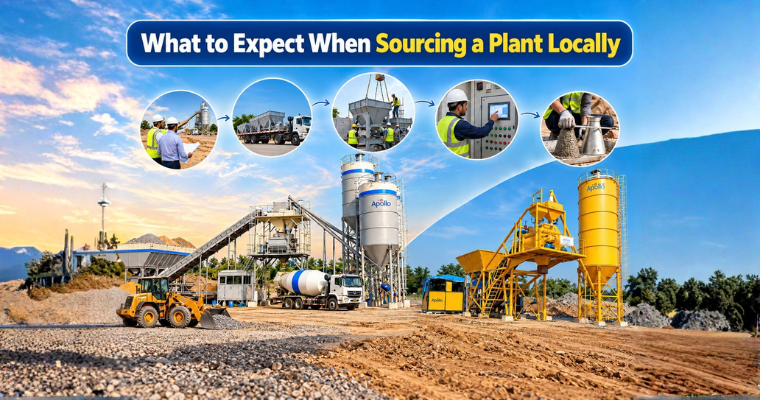
What to Expect When Sourcing a Plant Locally
The buying process for a Gujarat based buyer typically follows a similar sequence regardless of which manufacturer is ultimately chosen, though the timelines involved tend to compress when the manufacturer and installation team are already based within the state.
- A site visit and consultation to assess space, access, and power availability before finalizing a plant configuration.
- Delivery timelines that benefit from the manufacturer’s proximity, reducing the transport related delays common with plants sourced from outside the region.
- Installation and commissioning support delivered by a team familiar with typical Gujarat site conditions and common local aggregate and water sources.
- Ongoing calibration support scheduled around the state’s IS 4925 requirements without the delays that come with coordinating a distant service team.
Beyond Ahmedabad: Serving Gujarat’s Broader Construction Market
While Ahmedabad represents a significant share of Gujarat’s construction activity, demand for RMC and batching plants extends across the state, including Surat’s textile and industrial belt, Vadodara’s petrochemical and industrial corridor, and Rajkot and Saurashtra’s growing urban and infrastructure projects. Apollo Inffratech’s Mehsana base supports delivery and service across this broader footprint, since most of these locations sit within a manageable service radius of the manufacturing facility.
For contractors managing projects spread across multiple districts within the state, working with a single Gujarat based manufacturer also simplifies coordination, since installation teams, spare parts logistics, and calibration scheduling can be handled through one regional relationship rather than juggling different vendors or waiting on support routed through distant regional offices.
Questions Local Buyers Commonly Ask During Evaluation
- How quickly can a plant be delivered and commissioned once an order is confirmed, given the site’s distance from the manufacturing facility?
- Can the manufacturer provide references from existing installations elsewhere in Gujarat running under comparable site conditions?
- What calibration and maintenance schedule is recommended given the state’s monsoon pattern and typical site power supply conditions?
- Is a compact or inline configuration more appropriate for a specific urban plot, and what site preparation does each option require?
Conclusion
For buyers across Ahmedabad and Gujarat, sourcing an RMC plant or concrete batching plant from a manufacturer based within the state offers practical advantages in delivery speed, installation support, and ongoing calibration and maintenance access, on top of whatever equipment specification is ultimately chosen. These regional factors matter as much to a plant’s long term reliability as its rated capacity or automation level, particularly given how much a plant’s calibration schedule and service responsiveness affect its output consistency over years of operation.
Apollo Inffratech’s ATP series, manufactured at its Mehsana facility, is built to serve both the space constrained urban sites common across Ahmedabad and the high volume infrastructure corridors running through the rest of the state. Reach out to discuss your project location and requirements.
Frequently Asked Questions
RMC Plant and Concrete Batching Plant Manufacturer in Gujarat and Ahmedabad
Does Apollo Inffratech manufacture its concrete batching plants in Gujarat?
Yes, Apollo Inffratech's complete ATP series of concrete batching plants is manufactured at an ISO certified facility in Mehsana, Gujarat, supporting delivery and service across Ahmedabad and the wider state.
What type of batching plant is best suited for an Ahmedabad urban construction site?
Space constrained urban sites in Ahmedabad generally favor compact batching plants, which need no separate foundation, offer a smaller footprint, and can be erected quickly compared to a stationary inline unit.
Are higher capacity inline plants used for highway projects in Gujarat?
Yes, highway and expressway construction across Gujarat typically requires sustained, high volume concrete output, which is where inline plants in the 60 to 120 cubic meter per hour range are generally deployed.
Why does sourcing a batching plant locally in Gujarat matter?
A manufacturer based in the state can typically offer shorter delivery timelines, faster installation support, and more responsive calibration and maintenance service, since travel distance for both delivery and ongoing support is reduced.
Does Apollo Inffratech serve areas of Gujarat outside Ahmedabad?
Yes, Apollo Inffratech's Mehsana facility supports delivery and service across Gujarat's broader construction market, including Surat, Vadodara, Rajkot, and the Saurashtra region.
Can a single manufacturer support both a captive site plant and a future commercial RMC expansion in Gujarat?
Yes, a manufacturer offering a range of configurations, such as Apollo Inffratech's compact and inline ATP models, allows a buyer to start with a captive plant for one project and later add or upgrade capacity for commercial RMC supply without switching vendors.
Share At:




Listen to the Audio Version
Table of Contents