
Table of Contents
The 3-Batch System — The Hidden Driver of Batching Plant Productivity
When contractors and project managers evaluate concrete batching plants, most focus on the rated output capacity printed in the specification sheet — 30 m³/hour, 60 m³/hour, 120 m³/hour. What the specification sheet rarely explains is how much of that theoretical capacity the plant actually delivers under real construction site conditions. The answer depends almost entirely on the production system inside the plant, and the most important production system in Apollo Inffratech’s ATP series is the proprietary 3-batch system.
Understanding the 3-batch system is not a technical luxury for engineers — it is essential knowledge for anyone making a batching plant investment decision. The difference between a plant that delivers 65% of rated capacity and one that delivers 90% is not a minor operational detail. Across a 12-month infrastructure project, that gap translates into hundreds of additional plant operating hours, thousands of additional litres of fuel, higher labour costs, and significant risk to project completion timelines.
This article explains exactly what the 3-batch system is, how it works mechanically and through automation, why it produces such a significant productivity advantage, and why Apollo Inffratech’s implementation of this system is a genuine differentiator in India’s concrete batching plant market.
 Call Now!
Why Conventional Batching Plants Fall Short of Rated Capacity
To understand the 3-batch system, it helps to first understand why conventional batching plants underperform their rated output figures. In a standard batching plant, concrete production follows a strictly sequential cycle: the aggregate weighing system measures and holds the required quantities of sand and coarse aggregate; the conveyor transfers the weighed aggregates to the mixer; cement, water, and admixtures are added; the mixer runs for the specified mixing time; and finally the mixed concrete is discharged into the transit mixer truck or receiving hopper. Only after discharge is complete does the weighing cycle for the next batch begin.
This sequential approach means that large portions of the plant’s equipment are idle at any given moment. During mixing, the weighing system sits empty and unproductive. During discharge, the mixer is open and the weighing system remains idle. During aggregate transfer on the conveyor, neither the weighing system nor the mixer is running productively. When these idle periods are added up across a full production day, a conventional batching plant typically achieves only 60 to 70% of its theoretical hourly output — sometimes less under unfavourable conditions.
This is not a design failure — it is simply the result of sequential processing. The question Apollo Inffratech’s engineers addressed was whether the production cycle could be restructured to eliminate this idle time. The answer was the 3-batch system.
How Apollo Inffratech’s 3-Batch System Works
Apollo Inffratech’s 3-batch system restructures the production cycle so that three separate batches are in progress simultaneously at three different stages of the production process. At any given moment during continuous operation: Batch 1 is being discharged from the mixer into the transit mixer truck, Batch 2 has completed its mixing cycle and is ready for discharge as soon as Batch 1 is complete, and Batch 3 is currently being weighed by the aggregate weighing system in preparation for the next mixer loading.
This overlapping architecture means the plant is never truly idle at any stage. As soon as one batch completes a stage, the next batch immediately advances to fill it. The mixer is in continuous use — as one batch discharges, the next is loaded. The weighing system is in continuous use — as one batch is transferred to the mixer, the next weighing cycle begins. The conveyor runs in continuous cycles between stages.
The result is a plant that runs at approximately 90% of its theoretical rated output — a 20 to 30% improvement over conventional sequential production. For Apollo Inffratech’s ATP 60, which has a rated capacity of 60 m³/hour, the 3-batch system delivers a real-world output of approximately 54 m³/hour. For the ATP 120, real-world output approaches 108 m³/hour.
Read Our Article
Buyer’s Checklist to Evaluate Concrete Batching PlantsThe Role of PLC Automation in the 3-Batch System
Running three concurrent production batches without compromising weighing accuracy or mixing quality requires a level of coordination that cannot be achieved manually. Apollo Inffratech’s 3-batch system is managed entirely by the PLC-based control system fitted across all ATP series inline batching plants.
The PLC coordinates the precise timing of every gate, valve, conveyor, and mixer across all three concurrent batch stages. It monitors aggregate weights in real time and adjusts gate closure timing to hit the target weight to within ±1% on every batch — even while other batches are simultaneously in progress at different stages of the production cycle. This precision is maintained through quick exhaust valves fitted to all pneumatic cylinders in Apollo Inffratech’s plants, which ensure that material discharge gates open and close with millisecond-level timing accuracy regardless of operating conditions.
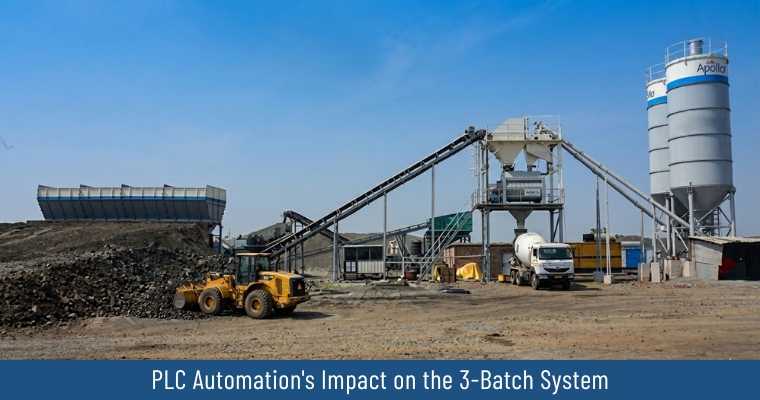
Without PLC automation of this sophistication, a 3-batch system would be unworkable — the complexity of manually coordinating three concurrent production stages would introduce errors, delays, and inconsistencies that would negate the efficiency gains. The integration of Apollo Inffratech’s 3-batch system with the PLC control architecture is what makes it a reliable, repeatable productivity advantage rather than a theoretical concept.
Quantifying the Impact – Project Economics of the 3-Batch System
The practical significance of the 3-batch system becomes most apparent when you calculate its financial impact on a specific project scenario. Consider a highway construction project requiring 120,000 m³ of concrete over a 12-month construction season of approximately 280 working days. The project has a daily concrete requirement of approximately 430 m³.
With a conventional batching plant rated at 60 m³/hour operating at 65% efficiency, real output is approximately 39 m³/hour. Meeting the 430 m³/day target requires approximately 11 hours of plant operation per day. Across 280 working days, total plant operating hours are approximately 3,080 hours. At a fuel cost of approximately 250 rupees per operating hour, total fuel expenditure is approximately 770,000 rupees.
With Apollo Inffratech’s ATP 60 and the 3-batch system operating at 90% efficiency, real output is approximately 54 m³/hour. The same 430 m³/day target is met in approximately 8 hours of operation. Across 280 working days, total plant operating hours are approximately 2,240 hours — 840 fewer hours than the conventional plant. Fuel savings alone total approximately 210,000 rupees, and 840 hours of saved production time reduces driver overtime, mixer truck idle time, and supervisor hours proportionally.
This calculation does not include the schedule benefit — finishing each day’s production two to three hours earlier provides a buffer against unexpected delays and reduces the risk of project milestones being missed.
Our Other Product
Concrete Block Making Machine3-Batch System Across the ATP Series
Apollo Inffratech’s 3-batch system is not exclusive to any single model — it is a standard feature across the entire Inline Batching Plant range. The ATP 30, ATP 45, ATP 60, ATP 75, ATP 90, ATP 100, and ATP 120 all incorporate the 3-batch system as part of their standard configuration. This means the productivity advantage scales proportionally with each model’s rated capacity, providing consistent efficiency across the full range.
For buyers evaluating Apollo Inffratech’s Compact Batching Plant series (ATP 25–75), it is worth noting that the compact plant’s single weighing and conveying belt design delivers its own form of cycle efficiency optimised for the compact plant’s operational profile — though the specific 3-batch overlapping architecture is the distinguishing feature of the inline series.
 Email Us Today!
About Apollo Inffratech and the ATP Inline Series
Apollo Inffratech Pvt. Ltd., headquartered in Mehsana, Gujarat, developed the 3-batch system as a proprietary productivity innovation for its Inline Batching Plant range. As one of India’s leading concrete construction equipment manufacturers with ISO certification and international technology partnerships, Apollo Inffratech has built the ATP series to consistently outperform competing batching plants in real-world output efficiency. The 3-batch system is one of several design innovations that make the ATP series the preferred choice for infrastructure contractors, RMC operators, and project developers requiring reliable, high-productivity concrete production in India.
Frequently Asked Questions
What is a 3-Batch System in a Concrete Batching Plant and Why Does It Matter?
What exactly is a 3-batch system in a concrete batching plant?
Apollo Inffratech's 3-batch system is a production architecture where three batches are simultaneously in progress at different stages — one weighing, one mixing, one discharging. This eliminates idle time in the production cycle and allows the plant to achieve approximately 90% of its theoretical rated output in real operating conditions.
How much does the 3-batch system improve real-world concrete output?
Conventional batching plants achieve 60–70% of rated capacity due to sequential idle time. Apollo Inffratech's 3-batch system raises this to approximately 90% — a 20 to 30% improvement. For a 60 m³/hour rated plant, this means approximately 12–15 additional m³ of concrete per hour compared to a conventional plant of the same rated capacity.
Does the 3-batch system affect concrete quality or weighing accuracy?
No. Apollo Inffratech's PLC-based control system maintains ±1% weighing accuracy across all three concurrent batch stages. Quick exhaust valves on all pneumatic cylinders ensure precise gate timing regardless of the overlapping production cycle. Concrete quality is fully maintained while production efficiency is significantly improved.
Is the 3-batch system available on all Apollo Inffratech batching plant models?
The 3-batch system is standard across Apollo Inffratech's full Inline Batching Plant range - ATP 30, ATP 45, ATP 60, ATP 75, ATP 90, ATP 100, and ATP 120. It scales proportionally with each model's rated capacity.
How does the PLC system coordinate the 3-batch production cycle?
Apollo Inffratech's PLC controls the timing of all gates, conveyors, mixers, and valves across the three simultaneous batch stages with millisecond precision. It monitors real-time aggregate weights and adjusts gate closure timing to hit ±1% accuracy on every batch while other batches continue progressing through their stages simultaneously.
What is the fuel cost saving from using the 3-batch system on a large project?
Savings vary by project size and fuel rates. As an example, on a project requiring 120,000 m³ of concrete, the 3-batch system can reduce plant operating hours by approximately 800 hours compared to a conventional plant of equivalent rated capacity - translating to substantial fuel, labour, and overhead cost savings.
Can I calculate my own project savings from the 3-batch system?
Yes. Apollo Inffratech's technical sales team can assist in calculating project-specific productivity and cost comparisons between ATP series plants and conventional alternatives. Contact Apollo Inffratech for a project-specific analysis based on your concrete volume, timeline, and operational cost parameters.
Share At:




Listen to the Audio Version
Table of Contents