
Table of Contents
The Commercial Case for Inline Batching Plants in India’s RMC Industry
India’s ready-mix concrete (RMC) industry has undergone a significant transformation over the past decade. What was once a niche product used only on large infrastructure projects has become the preferred concrete supply method for a growing share of residential, commercial, and infrastructure construction in India’s tier-1 and tier-2 cities. As demand for RMC has grown, so has the sophistication of the equipment choices available to plant operators — and the financial stakes of getting that equipment choice right.
Among India’s established and growing RMC companies, one consistent equipment preference has emerged: inline concrete batching plants over compact models for commercial RMC operations. This preference is not arbitrary — it reflects the economic realities of commercial concrete production, where output capacity, transit mixer fleet efficiency, customer service reliability, and cost per cubic metre of concrete determine whether an RMC business is profitable.
Apollo Inffratech Pvt. Ltd. manufactures both inline and compact batching plants, and the company’s technical sales team works closely with RMC operators across India in matching the right plant type to each business’s specific market and operational requirements. This article examines the reasons behind the industry’s preference for inline plants in commercial RMC operations.
 Email Us Today!
What Distinguishes a Commercial RMC Operation from a Project Batching Plant?
A project batching plant is set up to serve a single defined construction project. Its concrete demand is relatively predictable, its quality specifications are fixed for the project duration, and it operates until the project’s concrete requirements are fulfilled. Once the project is complete, the plant may be dismantled, relocated, or stood down.
A commercial RMC plant operates as a permanent or long-duration business serving multiple customers simultaneously. On any given day, an RMC plant may receive orders for M20 concrete for a residential foundation, M35 for a commercial building column, M40 for a highway contractor, and M50 for a precast element — all from different customers, all to be supplied within defined delivery windows. The plant must switch between mix designs rapidly, dispatch transit mixers on tight schedules, and maintain quality consistency across all concrete grades simultaneously.
This commercial complexity — serving multiple customers, multiple mix designs, and multiple simultaneous delivery schedules — is what drives RMC operators toward higher-capacity, more automated equipment. Compact plants can handle simpler operations, but the sustained peak demand of a busy commercial RMC plant is better served by the inline plant’s higher output architecture.
Output Capacity — The Primary Commercial Driver
The most direct reason RMC companies prefer inline batching plants is output capacity. Apollo Inffratech’s Inline Batching Plants range from 30 m³/hour (ATP 30) to 120 m³/hour (ATP 120), with the ATP 60, ATP 75, and ATP 90 being particularly popular among mid-to-large RMC operators. Apollo’s Compact Batching Plant series tops out at 75 m³/hour — capable for smaller RMC operations, but reaching its limit as commercial volume grows.
For an RMC company operating in a busy urban market, peak hour demand — the busiest single hour of the production day when multiple customers need simultaneous deliveries — can easily reach 50 to 80 m³/hour. At these demand levels, the ATP 60 or ATP 75 Inline plant provides the output headroom needed to keep the transit mixer fleet fully loaded and dispatched during peak periods without trucks queuing at the plant gate.
Transit mixer queue time at the RMC plant is one of the most visible indicators of plant capacity stress — and one of the most damaging to customer relationships. When trucks wait more than 15 to 20 minutes for loading, drivers become frustrated, delivery schedules fall behind, customers miss their pour windows, and complaints follow. An inline plant with sufficient capacity eliminates this bottleneck.
The 3-Batch System — Protecting RMC Plant Revenue
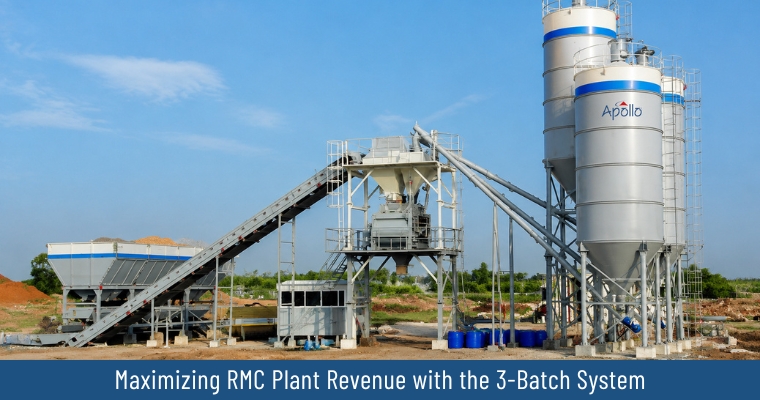
For an RMC company, plant downtime and underperformance translate directly into lost revenue. Every hour the plant cannot supply concrete because it has fallen behind demand means lost sales, disappointed customers, and potential permanent loss of business to competitors. Apollo Inffratech’s proprietary 3-batch system — which delivers approximately 90% of rated output compared to 60–70% from conventional plants — is therefore a significant commercial asset for RMC operators.
A conventional 60 m³/hour batching plant operating at 65% efficiency delivers 39 m³/hour. Apollo Inffratech’s ATP 60 with the 3-batch system delivers approximately 54 m³/hour — 15 additional m³ of concrete per hour. Over a 10-hour production day, that is 150 additional m³ of concrete that can be sold to customers. At an average RMC price of 5,000 rupees per m³, the 3-batch system’s efficiency advantage generates approximately 750,000 rupees of additional daily revenue potential compared to a conventional plant of the same rated capacity. Across a full operating year, the revenue differential is substantial.
Multiple Mix Design Capability — Serving Diverse RMC Customers
Commercial RMC operations serve customers with widely varying concrete specifications. From M20 for plain concrete fills to M60 for prestressed structural elements, the ability to switch between mix designs quickly and accurately is essential for serving a diverse customer base without errors that lead to rejected loads.
Apollo Inffratech’s PLC-based control system stores multiple concrete mix designs that the plant operator can recall instantly at the push of a button. The system automatically adjusts all ingredient quantities to match the selected mix design and maintains the same ±1% weighing accuracy regardless of which grade is being produced. Between batch cycles, switching from one mix design to another takes seconds — allowing the plant to serve multiple customers with different specifications within the same production hour without manual recalculation or increased error risk.
This mix design flexibility is equally important for quality management. When a customer receives concrete that does not meet specification — whether because the wrong mix design was selected or because a weighing error occurred — the financial and reputational consequences for the RMC company can be severe. Apollo Inffratech’s automated mix design management virtually eliminates this risk.
Cost Per Cubic Metre — The Long-Term Economic Argument
The economic case for inline plants over compact plants in commercial RMC is clearest when calculated on a cost-per-m³ of concrete produced basis. The inline plant’s higher purchase price is a fixed one-time cost. The productivity advantages — more concrete per hour, longer operational life, lower maintenance frequency per m³, and fewer instances of capacity-related customer service failures — generate savings that accumulate across thousands of production days.
Apollo Inffratech’s inline plants are built with heavy-duty structural frames and components designed for continuous multi-shift operation over multiple years. The robust construction reduces maintenance frequency and extends the intervals between major overhauls compared to lighter-duty compact plant designs. At high annual production volumes — 100,000 m³ or more per year — the fixed plant cost is spread across a much larger concrete volume, making the cost per m³ of the inline plant increasingly competitive relative to a compact plant that may require more frequent maintenance at the same throughput.
After-Sales Support — Keeping the RMC Plant Running
For a commercial RMC operation, unplanned plant downtime is potentially the most expensive single event that can occur. If the plant stops unexpectedly on a busy working day, every transit mixer in the fleet is idle, customer deliveries are missed, and contracts may be at risk. Rapid technical support response is not a luxury for RMC operators — it is a business continuity requirement.
Apollo Inffratech provides Annual Maintenance Contracts for all ATP series inline plants used in RMC operations. These contracts cover scheduled preventive maintenance visits — which significantly reduce the frequency of unplanned stoppages — priority spare parts supply from Apollo’s nationwide distribution network, and on-call technical support for fault diagnosis and repair. Apollo Inffratech’s service network covers major cities and regional centres across India, ensuring that RMC plants in both urban and peri-urban locations have access to prompt technical assistance when needed.
 Connect with Us Today!
About Apollo Inffratech — Preferred Batching Plant Manufacturer for India’s RMC Sector
Apollo Inffratech Pvt. Ltd., headquartered in Mehsana, Gujarat, is one of India’s most experienced manufacturers and suppliers of concrete batching plants for the ready-mix concrete industry. The company’s ATP series — particularly the ATP 60, ATP 75, ATP 90, and ATP 100 inline models — have become established equipment choices among India’s leading RMC operators. Apollo Inffratech’s combination of 3-batch system productivity, PLC automation, ISO-certified manufacturing, and comprehensive after-sales service makes it the most complete batching plant partner for Indian RMC businesses at every scale of operation.
Frequently Asked Questions
Why RMC Companies in India Prefer Inline Batching Plants Over Compact Models
Why do RMC companies prefer inline batching plants over compact plants?
RMC companies prefer inline plants for higher sustained output capacity, the 3-batch system's ~90% efficiency that keeps transit fleets moving, multiple mix design capability for diverse customers, and lower cost per m³ at high production volumes. Apollo Inffratech's ATP 60 to ATP 120 inline series is purpose-suited for commercial RMC operations.
Which Apollo Inffratech model is most popular with RMC operators in India?
Apollo Inffratech's ATP 60 and ATP 75 are among the most widely used models by Indian RMC operators. The ATP 60 suits mid-scale operations; the ATP 75 and ATP 90 serve larger businesses. The ATP 30 is a popular starting point for new RMC businesses entering smaller markets.
How does the 3-batch system help RMC plant profitability?
By delivering approximately 90% of rated output versus 60–70% from conventional plants, Apollo Inffratech's 3-batch system produces significantly more concrete per operating hour. This additional output translates directly into higher daily revenue potential and lower cost per m³ — the two most important economic metrics for an RMC business.
Can Apollo Inffratech's inline batching plants handle multiple concrete mix designs?
Yes. Apollo Inffratech's PLC control system stores and recalls multiple mix designs instantly. Switching between grades takes seconds, with ±1% weighing accuracy maintained across all specifications. This capability is essential for commercial RMC operations serving customers with diverse concrete grade requirements.
Is a compact batching plant ever suitable for RMC operations?
Yes, for smaller RMC businesses. Apollo Inffratech's Compact ATP 45 or ATP 75 works well for low-to-medium volume commercial RMC in areas with modest demand. As the business grows, upgrading to an inline plant — or adding a second plant — is the logical next step.
What maintenance support does Apollo Inffratech provide for RMC plants?
Apollo Inffratech's Annual Maintenance Contract for RMC plants includes scheduled preventive maintenance, priority spare parts supply, and on-call technical support. Regular preventive maintenance significantly reduces unplanned stoppages — the most damaging event for an RMC business's customer relationships and revenue.
Share At:




Listen to the Audio Version
Table of Contents