
Table of Contents
IS Code Compliance for Concrete Batching Plants — A Complete Guide
Any contractor or company operating a concrete batching plant on a construction project in India must ensure their equipment and processes comply with the relevant Indian Standards published by the Bureau of Indian Standards (BIS). This is not optional — on government-funded infrastructure projects, NHAI contracts, state public works department projects, and any project subject to quality audits, non-compliance with IS code requirements can result in concrete rejection, project penalties, and compliance notices that disrupt construction schedules.
Understanding IS code requirements for concrete batching plants is therefore essential knowledge for contractors, plant operators, project managers, and procurement teams involved in batching plant selection. This article provides a comprehensive overview of the key IS codes applicable to concrete batching plants in India, explains what each code requires, and shows how Apollo Inffratech’s ATP series batching plants are designed to meet these requirements.
 Call Us Now!
IS 4925 — The Central Standard for Batching Plant Design and Operation
IS 4925: Concrete Batching and Mixing Plants — Specification is the foundational Indian Standard governing the design, performance, and operation of concrete batching plants. It was developed by the Bureau of Indian Standards to establish minimum requirements for concrete production plant equipment across India’s construction industry.
IS 4925 covers six main areas: classification of plants by automation level, requirements for weighing system design and accuracy, specifications for concrete mixers and mixing performance, requirements for control systems and batching automation, procedures for testing plant performance, and requirements for maintenance and calibration records. Each of these areas has direct implications for batching plant procurement and operation.
The classification system under IS 4925 divides batching plants into four classes. Class I plants are fully automatic — the control system manages all weighing, batching, mixing, and discharge operations without manual intervention in the batching process. Class II plants are semi-automatic, requiring some manual initiation of automatic sequences. Class III plants have individual automatic functions without overall system integration. Class IV plants are fully manual. For major infrastructure projects, NHAI contracts, and state highway works, Class I batching plants are the expected standard.
Apollo Inffratech’s ATP series Inline and Compact Batching Plants with PLC-based control systems qualify as Class I under IS 4925. The fully automatic PLC manages all batching operations — aggregate weighing, cement dispensing, water metering, admixture dosing, mixing cycle timing, and discharge — without manual intervention, meeting the highest classification under the standard.
Weighing Accuracy Requirements Under IS 4925
IS 4925 specifies maximum permissible weighing error tolerances for each ingredient category. For cement and supplementary cementitious materials such as fly ash, the permitted deviation is ±2% of the required batch mass. For coarse and fine aggregates, the permitted tolerance is ±3%. For water, the permitted tolerance is ±1%. For chemical admixtures, the tolerance is ±3%.
These tolerances define the minimum acceptable accuracy — not the target accuracy. Well-designed batching plants should aim to perform significantly better than the IS 4925 minimum tolerances to provide a safety margin against the natural variability of plant operation. Apollo Inffratech’s ATP series achieves ±1% accuracy across all batch ingredients — better than the IS 4925 requirements for cement and significantly better than the requirements for aggregates.
The precision of Apollo Inffratech’s weighing system results from three integrated design elements: precision load cells with digital PLC integration that monitor real-time weight measurements, quick exhaust valves on all pneumatic material gates that ensure gate closure timing accuracy to within milliseconds, and a feeder screen on the aggregate bins that prevents oversized material from causing gate jamming or weight measurement errors. Together, these elements produce weighing performance that consistently exceeds IS 4925 requirements.
IS 456 — Concrete Quality Requirements Affecting Batching Plant Operations
IS 456: Plain and Reinforced Concrete — Code of Practice is India’s foundational standard for the structural design and construction of concrete structures. While IS 456 primarily governs the design of concrete structures, several of its provisions directly affect how batching plants must be operated when producing concrete for structural applications.
IS 456 requires that all structural concrete be batched by weight — not by volume. This requirement eliminates the historical practice of batching by the number of bags of cement or by volumetric measures of aggregates, which introduced significant variability in concrete quality. Weight batching, as used in all Apollo Inffratech batching plants, ensures that the actual quantities of each ingredient precisely match the specified mix design proportions on every batch.
IS 456 also specifies minimum cement content, maximum water-cement ratios, and minimum concrete strength requirements for different exposure conditions. Producing concrete that consistently meets these requirements demands a batching plant that weighs water accurately — because water-cement ratio is the single most influential variable controlling concrete strength and durability. Apollo Inffratech’s ATP series uses water flow meters or water weighing scales integrated with the PLC control to dispense exactly the specified water quantity on every batch.
IS 383 — Aggregate Quality and Its Impact on Batching Plant Performance
IS 383: Coarse and Fine Aggregates for Concrete — Specification governs the quality, gradation, and testing requirements for aggregates used in concrete production. While IS 383 is an aggregate procurement standard rather than a batching plant standard, it has important implications for how batching plants must be set up and operated.
IS 383 specifies gradation limits for different aggregate sizes — the proportions of each particle size that must be present in compliant coarse and fine aggregates. Aggregates that do not meet IS 383 gradation requirements produce concrete of unpredictable workability and strength, regardless of how accurately the batching plant weighs the ingredients.
Apollo Inffratech’s ATP series includes a feeder screen on the aggregate bins as a standard feature. This screen prevents oversized aggregate — particles larger than the specified maximum size for the mix design — from entering the weighing and conveying system. This protects the batching plant’s accuracy and mixing performance, and provides a practical first line of quality control for IS 383 compliance at the point of aggregate entry to the plant.
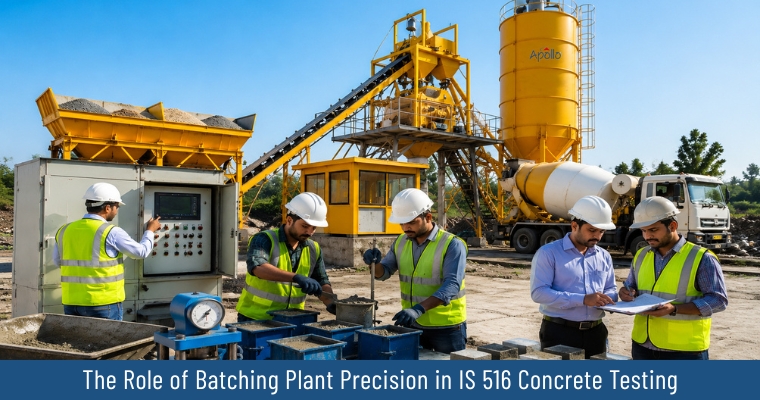
IS 516 — Concrete Testing and the Role of Batching Plant Accuracy
IS 516: Methods of Tests for Strength of Concrete specifies the procedures for sampling fresh concrete, casting test cubes, curing, and testing compressive strength. On infrastructure and government projects, IS 516 cube testing at defined frequencies is mandatory — and the results directly reflect the performance of the batching plant that produced the concrete.
When a batching plant consistently weighs all ingredients accurately and mixes them thoroughly, IS 516 cube test results are predictable and consistent. The 28-day compressive strength of properly batched concrete from the same mix design will vary within a narrow range from batch to batch. When cube test results show high variability or fail to meet the specified characteristic strength, the cause is often batching inaccuracy — inconsistent cement quantities, excessive or insufficient water, or poor mixing — all of which are prevented by the automated precision of Apollo Inffratech’s PLC batching system.
Consistent IS 516 cube test performance is not just a compliance requirement — it is a reflection of batching plant quality that clients, project engineers, and quality auditors use to assess contractor competence. An Apollo Inffratech ATP series plant gives contractors confidence that their IS 516 test results will consistently demonstrate concrete quality that meets or exceeds specification.
Calibration Requirements and Record-Keeping Under IS 4925
IS 4925 requires that batching plant weighing systems be calibrated and verified at defined intervals throughout the plant’s operational life. Calibration is required before plant commissioning at the start of a project, after any repair, replacement, or modification of weighing equipment, after plant relocation to a new site, and at regular intervals during continuous production — with most project quality plans specifying monthly calibration as a minimum requirement.
Calibration involves testing each load cell and weighing circuit against certified reference weights, verifying that the PLC control system registers the correct weight values, and checking gate closure accuracy through trial batches. The results must be documented in a calibration record that shows the date, the reference weights used, the measured values, and whether the plant passed or required adjustment. These records are subject to review during quality audits on NHAI and government projects.
Apollo Inffratech’s ATP series simplifies the calibration process through digital load cell integration with the PLC, which provides clear real-time weight readings that can be compared directly with reference weights. The Annual Maintenance Contract offered by Apollo Inffratech includes calibration support as a standard service element — Apollo’s service engineers assist with the calibration procedure and produce the documentation records required for IS 4925 compliance.
 Email Now!
About Apollo Inffratech — IS Code Compliant Batching Plants for Indian Construction
Apollo Inffratech Pvt. Ltd. designs and manufactures its Inline and Compact Batching Plant ranges to comply with IS 4925 and the associated IS codes applicable to concrete production in India. The fully automatic PLC-based control systems in Apollo’s ATP series meet Class I requirements under IS 4925. Weight-based batching with precision load cells and water metering meets IS 456 requirements. The feeder screen supports IS 383 aggregate quality control at the plant intake. And the consistent weighing accuracy of Apollo’s plants supports reliable IS 516 cube test performance throughout the project duration. Apollo Inffratech’s technical team provides IS code compliance consultation during plant selection and commissioning, and supports ongoing compliance through Annual Maintenance Contracts that include calibration assistance and documentation.
Frequently Asked Questions
IS Code Requirements for Concrete Batching Plants in India
What is IS 4925 and why does it matter for batching plant operators in India?
IS 4925 is the Indian Standard for Concrete Batching and Mixing Plants, published by the Bureau of Indian Standards. It specifies plant classification by automation level, weighing accuracy requirements, mixer performance standards, and calibration procedures. Compliance is mandatory for batching plants on NHAI and major government infrastructure projects in India.
What weighing accuracy does IS 4925 require for concrete batching plants?
IS 4925 permits ±2% for cement, ±3% for aggregates, and ±1% for water and admixtures. Apollo Inffratech's ATP series achieves ±1% across all ingredient categories — exceeding IS 4925 requirements and providing a safety margin that protects concrete quality even under variable operating conditions.
Which IS 4925 class do Apollo Inffratech's batching plants fall into?
Apollo Inffratech's ATP series with PLC-based fully automatic control qualifies as IS 4925 Class I — the highest classification. Class I plants automate all weighing, batching, mixing, and discharge operations without manual intervention, meeting the requirements for NHAI and major government infrastructure project batching plants.
Why does IS 456 require weight batching rather than volume batching for concrete?
Volume batching introduces significant variability because aggregate bulk density changes with moisture content and compaction. Weight batching measures actual mass regardless of volume variations, ensuring consistent mix proportions on every batch. Apollo Inffratech's plants use weight-based batching for all ingredients, fully complying with IS 456 requirements.
How often must a batching plant be calibrated to meet IS 4925 requirements?
IS 4925 requires calibration before commissioning, after repairs or relocation, and at regular intervals during production — typically monthly on infrastructure projects. Apollo Inffratech's Annual Maintenance Contract includes calibration support with proper documentation to meet IS 4925 compliance requirements.
How does Apollo Inffratech support IS code compliance for batching plant operators?
Apollo Inffratech provides IS 4925 compliance consultation during plant selection and commissioning. Annual Maintenance Contracts include calibration support, documentation assistance, and technical guidance on IS code compliance. Apollo's PLC batch recording system generates the production documentation required for IS 4925 and project quality plan compliance.
Share At:




Listen to the Audio Version
Table of Contents