
Table of Contents
Choosing the Right Concrete Batching Plant Capacity — Why It Matters
Choosing the right concrete batching plant capacity is one of the most consequential decisions a contractor, infrastructure developer, or ready-mix concrete (RMC) operator makes before starting a project. Select too little capacity and you face production bottlenecks, delayed concrete supply, and missed project milestones. Select too much and you have expensive equipment sitting underutilised, eroding your return on investment.
Apollo Inffratech Pvt. Ltd., one of India’s leading concrete construction equipment manufacturers, offers the ATP 30 and ATP 60 as two of the most popular models in its Inline Concrete Batching Plant range. Each is purpose-built for a defined band of project size and production demand. This article provides a detailed comparison of both models — their technical capabilities, ideal use cases, cost implications, and the practical factors that should determine your choice.
Understanding the difference between these two models requires going beyond the headline capacity figures. The real performance of any batching plant depends on its production system, automation level, structural durability, and how well it matches the daily concrete demand of the project it serves.
 Email Us Today!
What is the ATP 30 Inline Concrete Batching Plant?
The Apollo Inffratech ATP 30 is a 30 m³/hour inline concrete batching plant designed for small to medium-scale construction projects and entry-level commercial RMC operations. It is the smallest model in Apollo Inffratech’s Inline Batching Plant series and shares the same core engineering DNA as the larger models — including the proprietary 3-batch system, PLC-based automation, and heavy-duty square and rectangular hollow tube structural frame.
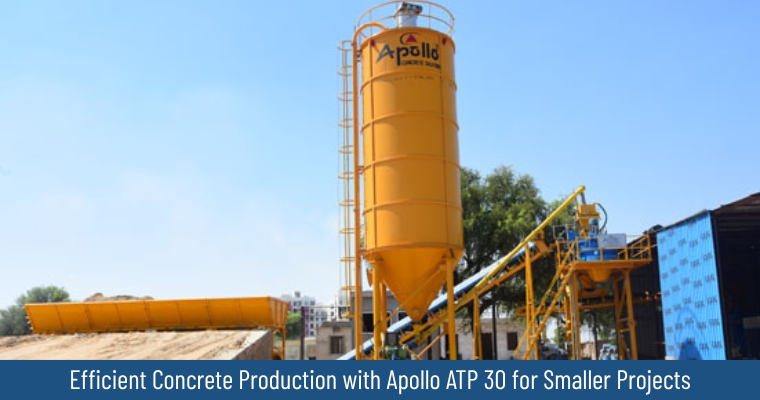
The ATP 30 is an ideal choice for residential housing developments, small commercial buildings, precast concrete product manufacturing units, road repair and maintenance projects, and contractors entering the RMC business for the first time. Its smaller investment cost compared to higher-capacity models reduces the financial risk for new entrants, while still delivering the technology and reliability that Apollo Inffratech is known for.
One frequently overlooked advantage of the ATP 30 is its physical footprint. As the smallest model in the inline range, it requires less site area for installation — an important consideration on constrained project sites in urban areas or on project sites where the plant needs to fit within a limited plot allocation. Despite its smaller size, the ATP 30 features the full suite of Apollo Inffratech’s quality engineering: MPCB protection on all motors, dust and water covers on electrical components, feeder screen for oversized aggregate protection, and quick exhaust valves on all pneumatic cylinders for weighing accuracy.
For an RMC plant serving a single residential project or a cluster of small projects within a localised area, the ATP 30 provides more than sufficient output while keeping capital expenditure at a manageable level. It can be upgraded to a higher-capacity model as the business grows.
What is the ATP 60 Inline Concrete Batching Plant?
The Apollo Inffratech ATP 60 is a 60 m³/hour inline batching plant occupying the mid-range of the ATP series. It is one of the most widely deployed models in India’s RMC and infrastructure sector, balancing output capacity, operational flexibility, and investment cost in a configuration that suits a broad range of project types.
At 60 m³ per hour, the ATP 60 can sustain continuous concrete production for medium to large construction projects — national and state highways, large commercial complexes, bridge projects, industrial facilities, and mid-scale RMC operations serving urban markets. Its larger aggregate bin configuration, higher cement hopper capacity, and more robust mixer options compared to the ATP 30 make it better equipped for extended continuous production across full working shifts.
The ATP 60 is available with twin-shaft or pan mixer configurations depending on the specific concrete types required by the project. Twin-shaft mixers are preferred for high-strength concrete grades and precast applications where thorough, homogeneous mixing is critical. Pan mixers offer flexibility for projects with varying mix design requirements across a single production day.
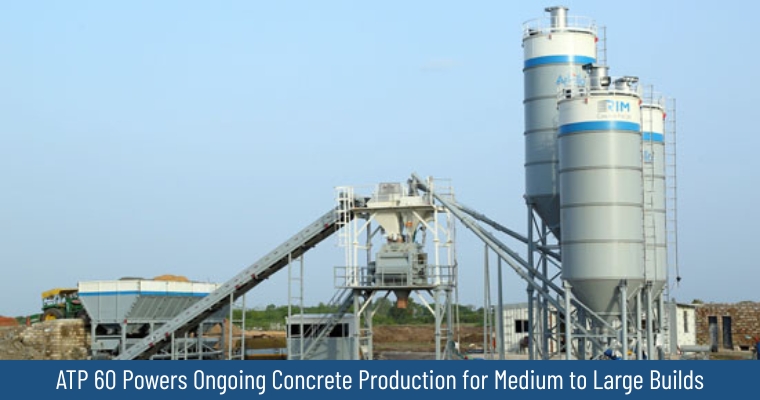
For RMC plant operators, the ATP 60’s 60 m³/hour capacity translates to the ability to keep a fleet of 6 to 8 transit mixer trucks consistently loaded and dispatched — a critical operational benchmark for commercial RMC businesses. Combined with Apollo Inffratech’s 3-batch system achieving approximately 90% output efficiency, real-world production from the ATP 60 consistently approaches 54 m³/hour under normal operating conditions.
3-Batch System — The Productivity Core of Both Models
Both the ATP 30 and ATP 60 incorporate Apollo Inffratech’s proprietary 3-batch system — the production method that sets the ATP series apart from conventional batching plants in India. In a standard batching plant, production is sequential: weigh, transfer to mixer, mix, discharge, then restart the weighing cycle. This creates significant idle time within each production cycle, limiting real-world output to 60–70% of rated capacity.
Apollo Inffratech’s 3-batch system runs three batches simultaneously at different stages. While Batch 1 is being discharged into the transit mixer, Batch 2 is completing its mixing cycle, and Batch 3 is already being weighed for the next cycle. This overlapping production eliminates idle time and lifts real-world output to approximately 90% of rated capacity — a 20 to 30% productivity improvement that directly affects project timelines and operating economics.
For the ATP 30, this means an effective real-world output of approximately 27 m³/hour. For the ATP 60, it means approximately 54 m³/hour. These are the figures you should use for production planning — not the theoretical rated capacities.
Our Other Product
Inline Concrete Batching PlantTechnical Comparison — ATP 30 vs ATP 60
The ATP 30 is equipped with aggregate bins sized for smaller project throughputs, a cement weighing hopper in the lower capacity range, and a mixer suitable for 30 m³/hour production cycles. The ATP 60 features significantly larger aggregate bin storage — critical for sustained production without frequent refilling — a higher-capacity cement hopper, and a more powerful mixer suited to continuous multi-hour production runs.
Both models use the same PLC-based control system that delivers ±1% weighing accuracy across all batch ingredients. Both include quick exhaust valves on pneumatic cylinders, MPCB motor protection, feeder screens, and dust and water covers on all electrical components. The quality and reliability engineering is identical — the difference is purely in throughput capacity and the scale of site infrastructure each supports.
Foundation requirements are the same for both: both ATP 30 and ATP 60 are stationary inline plants requiring a concrete foundation. For contractors needing a no-foundation solution, Apollo Inffratech’s Compact Batching Plant range (ATP 25 to ATP 75) provides this option.
Cost Considerations — Which Model Gives Better Return on Investment?
The ATP 60 carries a higher purchase price than the ATP 30, reflecting its greater aggregate bin capacity, larger mixer, and more robust overall structure. However, for projects or RMC operations with concrete demands in the 40 to 60 m³/hour range, the ATP 60 often delivers a lower cost per cubic metre of concrete produced when calculated over the full production lifecycle.
The key calculation is cost per m³ of concrete produced — total plant ownership cost (purchase price, installation, maintenance, and fuel) divided by total cubic metres produced over the plant’s service life. When the ATP 60 operates close to capacity on a sustained basis, its higher fixed cost is spread across a much larger concrete volume, making it more economical per m³ than the ATP 30 operating at full capacity serving the same demand.
For projects or operations where demand is reliably below 30 m³/hour, the ATP 30 is the financially superior choice. For operations where demand regularly exceeds 30 m³/hour or peaks significantly above it, the ATP 60 is the right investment.
Which Model is Right for Your Specific Situation?
Choose the Apollo Inffratech ATP 30 if you are setting up a first RMC plant in a smaller market, operating on a project with a total concrete volume below 40,000 m³, working on residential or small commercial construction, running a precast concrete manufacturing unit with moderate production volumes, or operating in a location where capital investment must be kept to a minimum.
Choose the Apollo Inffratech ATP 60 if you are operating a commercial RMC plant serving multiple customers or sites, executing a highway, bridge, or large infrastructure project, require the plant to sustain production across multiple shifts, have a daily peak demand that regularly exceeds 200–250 m³, or are expanding an existing RMC business to serve a growing market.
 Call Now!
About Apollo Inffratech Pvt. Ltd.
Apollo Inffratech Pvt. Ltd. is headquartered in Mehsana, Gujarat, and is one of India’s largest manufacturers and suppliers of concrete construction equipment. With decades of manufacturing experience, ISO certification, and international technology partnerships with companies including Afinitas (USA), Carmix (Italy), Zenith (Germany), HEM Paving (USA), and MBK (Germany), Apollo Inffratech delivers globally benchmarked engineering standards through its Indian manufacturing facility. The ATP series of Inline Batching Plants — from ATP 30 to ATP 120 — is supported by a nationwide service network, Annual Maintenance Contracts, and a dedicated technical sales team that assists buyers with capacity planning and model selection before purchase.
Frequently Asked Questions
ATP 30 vs ATP 60 — Which Inline Batching Plant Capacity is Right for Your Project?
What is the concrete output of the ATP 30 batching plant per hour?
The Apollo Inffratech ATP 30 has a rated output of 30 m³/hour. With the proprietary 3-batch system, real-world production consistently approaches 27 m³/hour — approximately 90% of rated capacity. This makes it ideal for small to medium construction projects and entry-level RMC operations.
Can the ATP 60 be used for highway construction projects?
Yes. Apollo Inffratech's ATP 60 is widely used on state highway and national highway projects where daily concrete requirements are in the 300–500 m³ range. For larger NHAI expressway projects requiring more than 500 m³/day, the ATP 90 or ATP 120 is recommended.
Do both the ATP 30 and ATP 60 require a foundation?
Yes. Both models are stationary inline plants that require a concrete foundation for stability and accurate weighing. Apollo Inffratech's Compact Batching Plant series (ATP 25–75) offers a no-foundation alternative for contractors requiring quick installation without civil groundwork.
What is the difference between ATP 30 and CP 30 batching plant?
Apollo Inffratech's Inline Batching Plants are designated in the ATP series. The CP 30 designation is used by another manufacturer. Apollo's ATP 30 is a 30 m³/hour inline plant with the proprietary 3-batch system, PLC automation, and heavy-duty steel construction — contact Apollo Inffratech to compare specifications with any alternative model you are evaluating.
How long does it take to commission an ATP 60 on a project site?
Commissioning time for the Apollo Inffratech ATP 60 depends on site preparation and foundation completion. Apollo Inffratech's technical team provides on-site installation support and can assist in accelerating the commissioning timeline. Contact Apollo Inffratech for a project-specific installation plan.
Which model is better for an RMC business that is just starting?
For a new RMC business entering a market for the first time, Apollo Inffratech's ATP 30 is often the right starting point. It offers a lower initial investment while delivering reliable, high-quality concrete production backed by the same 3-batch system and PLC automation as the larger models. As the business grows, upgrading to the ATP 60 or ATP 75 is a straightforward next step.
Where can I get a price quote for the ATP 30 or ATP 60?
Contact Apollo Inffratech Pvt. Ltd. directly through apolloinffratech.com or call the sales team at their Mehsana, Gujarat headquarters. Apollo provides project-specific quotations based on your capacity requirements, site conditions, and any optional equipment or configurations you need.
Share At:




Listen to the Audio Version
Table of Contents