
Table of Contents
Inline vs Compact Concrete Batching Plant — Understanding the Choice
When a construction company, infrastructure contractor, or ready-mix concrete operator decides to invest in a concrete batching plant, one of the first questions that needs to be answered is: inline or compact? Both types serve the fundamental purpose of producing precise, high-quality concrete — but they differ significantly in their layout, installation requirements, capacity range, and the types of projects they are optimised for.
Apollo Inffratech Pvt. Ltd. manufactures both types under the well-established ATP series product line, making it possible for buyers to compare both options from a single trusted source and select the configuration that best matches their specific operational requirements. This article provides a comprehensive, side-by-side comparison of Apollo Inffratech’s Inline and Compact Concrete Batching Plants across all the dimensions that matter most to a buyer.
 Connect with Us Today!
Design and Layout – Inline vs Compact
Apollo Inffratech’s Inline Concrete Batching Plant uses a linear arrangement where aggregate bins, weighing system, conveyor belt, and mixer are positioned in a straight line. This configuration is specifically designed to create the smoothest, most uninterrupted material flow from storage to mixing — the foundation of the high-output, continuous production capability that the inline plant is known for.
The Compact Concrete Batching Plant integrates the same core components — aggregate bins, weighing system, conveyor, and mixer — in a significantly smaller overall footprint without the linear arrangement. The design priority for the compact plant is space efficiency and rapid installation, achieved partly through a single weighing and conveying belt that reduces the number of mechanical components and simplifies the material flow path.
The architectural difference between the two designs is not merely aesthetic. The inline layout optimises for throughput and sustained production. The compact layout optimises for flexibility, speed of installation, and minimal civil infrastructure requirements. Understanding this design philosophy is the key to choosing the right type for your situation.
Capacity Range – What Each Type Can Deliver
Apollo Inffratech’s Inline Batching Plant series covers a capacity range from 30 m³/hour (ATP 30) to 120 m³/hour (ATP 120), with models at ATP 45, ATP 60, ATP 75, ATP 90, and ATP 100 filling the intermediate steps. This range covers every scale of project from medium residential construction through to the largest national highway and infrastructure developments.
The Compact Batching Plant series ranges from 25 m³/hour (ATP 25) to 75 m³/hour (ATP 75), with models at ATP 31, ATP 45, and ATP 61. This range comfortably covers small to medium construction projects, precast concrete manufacturing, smaller RMC operations, and any application where output requirements do not exceed 75 m³/hour.
The two ranges overlap significantly between 30 and 75 m³/hour. In this overlapping zone, both an inline and a compact plant can technically meet the production requirement — and the deciding factor shifts from capacity to installation conditions, site constraints, and whether the plant needs to be relocated during or between projects.
Foundation and Installation – A Critical Practical Difference
The most practically significant difference between Apollo Inffratech’s Inline and Compact Batching Plants is the foundation requirement. The Inline series plants are stationary installations that require a properly designed and constructed concrete foundation. The foundation ensures structural stability for accurate weighing during continuous operation, proper load distribution from the aggregate bins and mixer, and long-term equipment life without structural fatigue.
Foundation preparation adds time and cost to the plant installation process — civil design, concrete work, curing time before plant erection, and ground preparation all contribute. For long-duration projects or permanent RMC installations, this additional upfront investment is fully justified by the operational benefits of a stable, high-capacity plant.
Apollo Inffratech’s Compact Batching Plant requires no concrete foundation whatsoever. The robust square and rectangular hollow tube steel frame provides all the structural rigidity needed for precise weighing and stable operation without any civil groundwork. This means the compact plant can be erected directly on a prepared, level surface — dramatically reducing setup time and total installation cost.
For contractors who move between projects, or project developers who need to commission a plant quickly to meet a contractual start date, the no-foundation design of the compact plant is a decisive advantage that can save weeks of preparation time and significant civil construction expenditure.
Space Requirements and Site Suitability
Apollo Inffratech’s Inline Batching Plants require more ground area than compact plants of equivalent capacity, because the linear arrangement spreads components along a longer axis. A properly laid out inline plant installation also needs space for aggregate stockpiles, transit mixer access roads, cement silo positioning, and operational circulation for vehicles and personnel. For permanent RMC installations or long-duration project sites, this space is typically available and the layout can be planned accordingly.
The Compact Batching Plant is designed specifically for sites where space is constrained. Its reduced footprint makes it suitable for urban construction sites where plot sizes are limited, quarry or industrial sites with restricted available area, temporary project installations where the plant occupies a minimal site footprint, and locations where environmental or planning restrictions limit the area available for construction plant.
Apollo Inffratech’s Compact plant is also easier to transport between sites. The more self-contained component layout simplifies dismantling, transport, and re-erection compared to an inline plant of equivalent or larger capacity.
Our Other Product
Compact Concrete Batching Plant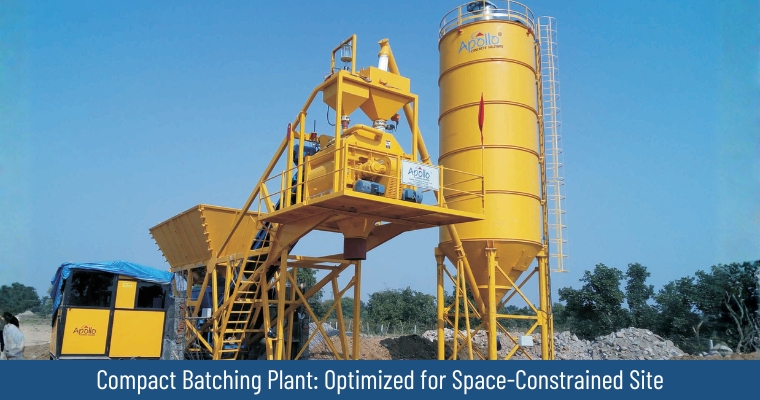
Automation and Concrete Quality – Equal Across Both Types
A common misconception is that compact plants offer lower concrete quality or less automation than inline plants. In Apollo Inffratech’s range, this is not the case. Both the Inline and Compact series use the same PLC-based fully automatic control systems that deliver ±1% weighing accuracy across all batch ingredients — cement, aggregates, water, and admixtures. Both types are equipped with quick exhaust valves on all pneumatic cylinders for gate timing precision, MPCB protection on all electrical motors, and dust and water covers on motor housings.
The feeder screen that protects the weighing system from oversized aggregates is standard on both plant types. Concrete produced by a well-operated Apollo Inffratech Compact plant is of identical quality to concrete produced by an Apollo Inffratech Inline plant of any capacity — the difference is in how much concrete can be produced per hour, not in the quality of what is produced.
Cost of Ownership – Inline vs Compact
At equivalent capacity levels — say, comparing the ATP 75 Compact with the ATP 75 Inline — the compact plant generally has a lower total installed cost because no foundation expenditure is required. The compact plant also has lower transportation and re-erection costs when relocating between sites.
However, for operations running at or near capacity continuously over extended periods, the inline plant’s design is optimised for long-duration sustained production in a way that can provide lower maintenance costs per m³ over the full operational life. Apollo Inffratech’s technical sales team can provide a total cost of ownership analysis for both types based on your specific production volume and operational requirements.
 Email Us Today!
About Apollo Inffratech Pvt. Ltd.
Apollo Inffratech Pvt. Ltd. is based in Mehsana, Gujarat, and is one of India’s most experienced manufacturers and suppliers of concrete construction equipment. The company’s ATP series of Inline and Compact Batching Plants covers every capacity requirement from 25 m³/hour to 120 m³/hour, all manufactured to ISO standards with PLC automation and international engineering quality. Apollo Inffratech’s nationwide service network, Annual Maintenance Contracts, and technical support team provide buyers with complete confidence in both product performance and long-term after-sales support. Whether you need an inline plant for a large infrastructure project or a compact plant for a smaller, space-constrained site, Apollo Inffratech is the single supplier for both.
Frequently Asked Questions
Inline Concrete Batching Plant vs Compact Batching Plant — A Complete Comparison
What is the main difference between an inline and compact batching plant?
The main differences are design layout, foundation requirement, and capacity range. Apollo Inffratech's Inline plants use a linear arrangement, require a concrete foundation, and go up to 120 m³/hour. Compact plants have a smaller footprint, need no foundation, and go up to 75 m³/hour. Both deliver the same concrete quality through PLC automation and ±1% weighing accuracy.
Can a compact batching plant produce the same quality concrete as an inline plant?
Yes. Apollo Inffratech's Compact and Inline Batching Plants both use PLC-based control systems with ±1% weighing accuracy, quick exhaust valves, and MPCB motor protection. Concrete quality is equivalent across both types — the difference is in output capacity and installation flexibility, not in the quality of concrete produced.
Which type is better for a project site with limited space?
Apollo Inffratech's Compact Batching Plant is specifically designed for sites with limited space. Its smaller footprint, no-foundation design, and more self-contained component layout make it ideal for confined urban construction sites, temporary installations, and locations where the plant footprint must be kept to a minimum.
Is the compact batching plant suitable for RMC operations?
Yes, for small to medium RMC operations. Apollo Inffratech's Compact ATP 45 or ATP 75 works well for smaller commercial RMC businesses. For larger RMC operations serving high-volume urban markets, the Inline series offers higher sustained capacity and is generally the more productive choice.
Can the compact batching plant be relocated between project sites?
Yes. Apollo Inffratech's Compact Batching Plant is designed for easier transportation and re-erection compared to inline plants. The no-foundation design means relocation involves dismantling, transporting, and re-erecting the plant without requiring new civil foundation work at the next site.
What is the largest capacity compact batching plant Apollo Inffratech makes?
The largest model in Apollo Inffratech's Compact series is the ATP 75, producing 75 m³/hour. For any project requiring more than 75 m³/hour, the Inline series — starting from ATP 30 and going up to ATP 120 — is the right product range.
Share At:




Listen to the Audio Version
Table of Contents