
Table of Contents
Why Apollo Inffratech’s Inline Batching Plants Are the Infrastructure Contractor’s Choice
India’s infrastructure ambitions are extraordinary in scale. The government’s capital expenditure on roads, highways, railways, airports, urban metros, and water infrastructure has reached historic highs in recent years and is expected to continue growing through this decade. The volume of concrete required to build, expand, and modernise this infrastructure is staggering — and the equipment used to produce that concrete must be capable of matching the scale, speed, and quality demands of the projects it serves.
 Call Now
Apollo Inffratech Pvt. Ltd. has been manufacturing concrete batching plants specifically for India’s construction and infrastructure sector for decades. The company’s Inline Concrete Batching Plants — the ATP series from ATP 30 to ATP 120 — have been designed with the specific demands of Indian infrastructure projects in mind: sustained high output under demanding site conditions, consistent concrete quality to meet specification standards, ease of operation by locally trained operators, and reliability that keeps the plant running throughout the project duration without costly unplanned stoppages.
This article examines in detail how Apollo Inffratech has engineered the ATP series to meet the requirements of large-scale Indian infrastructure projects — from the structural design decisions to the automation systems, from the production architecture to the after-sales support infrastructure.
The Scale of India’s Concrete Demand – Why Ordinary Plants Are Not Enough
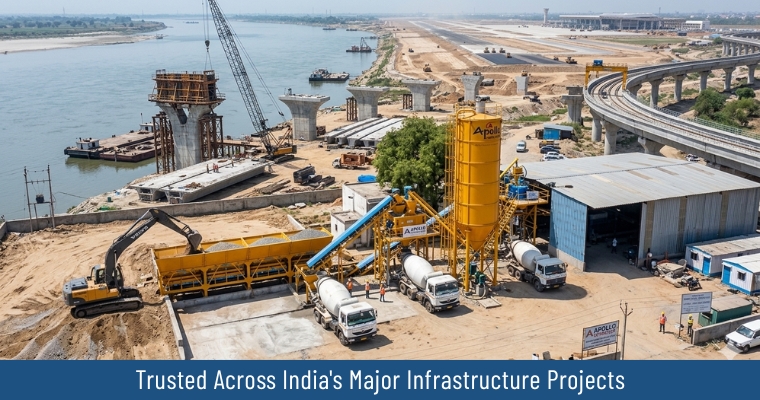
The scale of concrete consumption on India’s infrastructure projects challenges ordinary batching plant equipment in ways that smaller construction projects do not. A single 100-kilometre stretch of concrete road pavement on a national highway may require 500,000 m³ or more of concrete. A major river bridge can require 200,000 m³ for its foundations, piers, and superstructure. Airport runway reconstruction projects require large volumes of high-strength, precisely controlled concrete delivered within narrow time windows.
These projects cannot be served by batching plants that deliver 60% of their rated output or break down frequently under sustained operation. They require equipment that is engineered for continuous, high-efficiency production over months and years — not weeks. This is the market Apollo Inffratech’s ATP series has been specifically developed to serve.
High Output Capacity Across the Full ATP Range
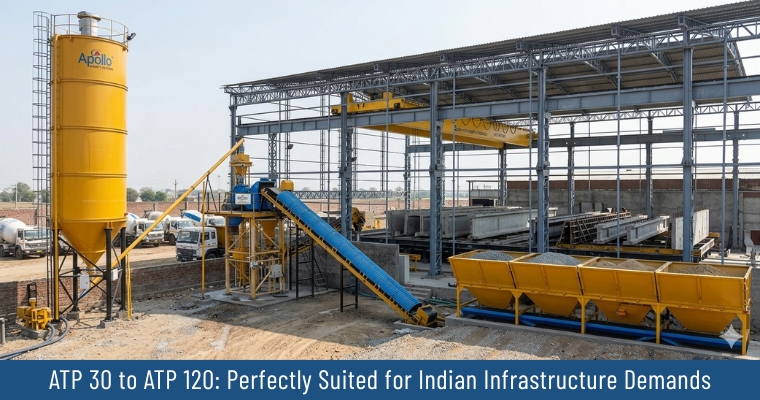
Apollo Inffratech’s ATP Inline series provides seven models covering outputs from 30 m³/hour to 120 m³/hour — ATP 30, ATP 45, ATP 60, ATP 75, ATP 90, ATP 100, and ATP 120. This comprehensive range ensures that infrastructure contractors of every scale can find the exactly right capacity without over-investing in excess output.
For the largest and most time-sensitive infrastructure projects — expressways with daily paving targets of 1,000 m³ or more, dam concrete pours requiring continuous supply over 24-hour cycles, and airport runway replacements with compressed construction windows — Apollo Inffratech’s ATP 90, ATP 100, and ATP 120 provide the sustained high-volume output that no smaller plant can deliver. These top-range models feature the largest aggregate bin capacities, highest cement weighing hopper specifications, and most robust mixer configurations in the ATP series.
For medium-scale infrastructure projects — state highway contracts, bridge construction, irrigation structures, and urban flyovers — the ATP 60 and ATP 75 provide the right balance of output capacity, investment level, and operational efficiency.
The 3-Batch System — Apollo Inffratech’s Productivity Innovation
The single most important performance differentiator of Apollo Inffratech’s ATP series is the proprietary 3-batch system. In conventional batching plants, production follows a sequential cycle — weigh, transfer, mix, discharge, repeat — with significant idle time between stages that limits real output to 60–70% of rated capacity. On a large infrastructure project, this gap between rated and actual output creates the need for additional plant operating hours that add cost and risk to the project schedule.
Apollo Inffratech’s 3-batch system eliminates idle time by running three batches simultaneously at overlapping stages. While one batch is being discharged into the transit mixer, the next batch is completing mixing, and the one after is already being weighed. The result is continuous, uninterrupted production that achieves approximately 90% of rated capacity — making the ATP series 20 to 30% more productive than conventional plants of equivalent rated output.
For a large infrastructure project manager planning concrete production schedules, the 3-batch system allows planning based on 90% of rated capacity rather than 65% — directly reducing the number of plant operating hours required to meet concrete volume targets, and creating schedule contingency that protects against unexpected delays.
Heavy-Duty Structural Engineering for Indian Site Conditions
Indian infrastructure projects operate in some of the most challenging environments in the world. Highway projects run through desert terrain, monsoon-affected regions, high-altitude mountain areas, and humid coastal zones. Dam projects are located in remote areas far from maintenance support. Urban metro and flyover projects operate amid the dust, vibration, and congestion of existing city environments.
Apollo Inffratech’s ATP series inline batching plants are built to perform reliably in all of these conditions. The structural frame of every ATP series plant is fabricated from heavy-duty square and rectangular hollow sections — a design choice that provides superior rigidity and corrosion resistance compared to open section or lighter fabricated structures. The robust frame maintains the geometric accuracy of the aggregate bin and weighing system alignment even under the vibration loads of continuous production over extended periods.
All electrical motors across the ATP series are protected by MPCB (Motor Protection Circuit Breaker) systems that prevent damage from electrical overloads — particularly important in areas with fluctuating power supply, which is common on remote project sites. Every motor has a dedicated cover protecting against dust and water ingress — a critical design feature given the dusty conditions of aggregate handling and the monsoon rainfall that affects most Indian construction sites for three to four months per year.
Our Other Product
Dry Type Batching PlantPLC Automation — Consistent Quality for Infrastructure Grade Concrete
National highway pavement concrete, bridge structural concrete, and precast infrastructure elements must meet strict mix design specifications — typically IS 456 and project-specific quality plans that define exact cement content, aggregate gradation, water-cement ratio, and strength requirements. Producing concrete that consistently meets these specifications requires batching plant automation that performs with precision on every single batch, not just on average.
Apollo Inffratech’s ATP series uses fully automatic PLC-based control systems that weigh all batch ingredients — aggregates, cement, water, and admixtures — to within ±1% of the specified target weight on every batch. Quick exhaust valves on all pneumatic cylinders maintain gate timing accuracy throughout continuous production, preventing the weighing drift that can occur in plants without this precision timing mechanism. A feeder screen on the aggregate bins prevents oversized material from entering the weighing system and compromising batch accuracy.
The PLC system stores multiple mix designs that can be recalled instantly for different concrete grades — critical when the same plant is producing M40 for road pavement and M50 for bridge elements on the same day. Batch records can be generated automatically for quality documentation, supporting the compliance requirements of NHAI and government project quality plans.
Proven Track Record Across India’s Infrastructure Sectors
Apollo Inffratech’s Inline Batching Plants have been deployed on infrastructure projects spanning national and state highways, major river bridges, irrigation and dam projects, airport runway construction, metro rail viaducts, urban flyover construction, and precast concrete manufacturing for infrastructure components. This broad cross-sector deployment has built Apollo Inffratech’s reputation as one of India’s most trusted batching plant manufacturers among the country’s leading infrastructure contractors.
Read Our Article
The Evolving Market Landscape of Concrete Batching Plants by 2030Apollo Inffratech Pvt. Ltd. is headquartered in Mehsana, Gujarat, and manufactures all ATP series plants at its facility on the Ahmedabad-Mehsana State Highway. The company holds ISO certification and has established international technology partnerships with Afinitas (USA), Carmix (Italy), Zenith (Germany), HEM Paving (USA), and MBK (Germany) — bringing internationally proven engineering standards to every plant manufactured. A nationwide service network provides Annual Maintenance Contracts, spare parts supply, and on-site technical support across India, ensuring that plants deployed on remote project sites receive the same standard of after-sales support as those in urban locations.
Frequently Asked Questions
How Apollo Inffratech’s Inline Batching Plants Are Built for Large-Scale Indian Infrastructure Projects
Which Apollo Inffratech batching plant model is best suited for expressway construction?
For expressway and large national highway construction, Apollo Inffratech's ATP 90, ATP 100, and ATP 120 are the recommended models. These high-capacity inline plants deliver 90–120 m³/hour and are designed for the sustained continuous production required by slip form paving operations on large highway contracts.
Can Apollo Inffratech's plants produce concrete to NHAI quality specifications?
Yes. Apollo Inffratech's ATP series uses fully automatic PLC batching with ±1% weighing accuracy, meeting the requirements of IS 4925 Class I batching plants. The system produces concrete consistently to NHAI specified mix designs including M40 road pavement concrete and high-grade bridge structural mixes.
Does Apollo Inffratech supply batching plants for precast concrete infrastructure?
Yes. Apollo Inffratech's ATP series includes configurations for precast concrete applications — including bridge segment casting, manhole and culvert production, and precast structural element manufacturing. Model-specific precast catalogues are available from Apollo Inffratech.
What is the maximum capacity concrete batching plant Apollo Inffratech makes?
The maximum capacity model in Apollo Inffratech's Inline Batching Plant range is the ATP 120, producing 120 m³/hour. With the 3-batch system operating at approximately 90% efficiency, real-world output from the ATP 120 approaches 108 m³/hour - sufficient for the most demanding large-scale infrastructure projects.
How does Apollo Inffratech support batching plants deployed on remote project sites?
Apollo Inffratech's nationwide service network covers project sites across India. Annual Maintenance Contracts include scheduled preventive maintenance visits, priority spare parts supply, and on-call technical support for fault diagnosis and repair. For large infrastructure projects with critical plant uptime requirements, Apollo Inffratech can arrange dedicated service support arrangements.
Are Apollo Inffratech's batching plants manufactured in India?
Yes. All Apollo Inffratech ATP series Inline Batching Plants are manufactured at the company's facility in Mehsana, Gujarat. Apollo holds ISO certification for its manufacturing operations. International technology partnerships bring globally proven engineering standards to the Indian manufacturing process.
Share At:




Listen to the Audio Version
Table of Contents