
Table of Contents
Batching Plant Compliance on NHAI Highway Projects — What Contractors Must Know
India’s National Highways Authority of India (NHAI) is responsible for the development and maintenance of the national highway network — one of the largest road infrastructure programmes in the world. With tens of thousands of kilometres of national highways under construction or upgrade at any given time, NHAI projects represent some of the highest-value and most technically demanding concrete production contracts in India’s construction industry.
Contractors working on NHAI highway projects face specific, non-negotiable requirements for their concrete production equipment. Unlike private construction projects where some flexibility in equipment specifications may be available, NHAI contracts are governed by detailed quality plans, IS code compliance requirements, and regular quality audits that hold contractors accountable for every batch of concrete produced on the project.
Selecting and operating the wrong batching plant on an NHAI project — one that does not comply with IS 4925 requirements, cannot consistently meet mix design specifications, or lacks adequate documentation capability — can result in concrete quality rejection, project penalties, and reputational damage that affects future contract eligibility. This article provides a comprehensive guide to batching plant requirements for NHAI highway projects and explains how Apollo Inffratech’s ATP series meets these requirements.
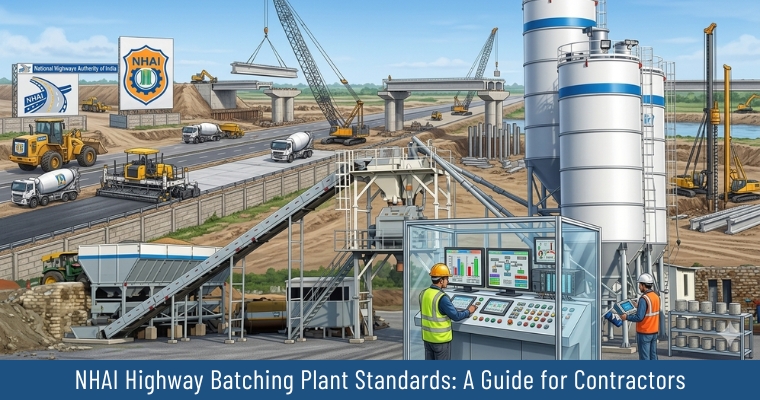
IS 4925 — The Governing Standard for Batching Plants on NHAI Projects
IS 4925 — Concrete Batching and Mixing Plants: Specification — is the Indian Standard published by the Bureau of Indian Standards that governs concrete batching plant design, performance, and operation in India. Compliance with IS 4925 is mandatory for batching plants used on NHAI and most major government-funded infrastructure projects.
IS 4925 classifies batching plants into four categories based on automation level. Class I plants are fully automatic — all weighing, mixing, and discharge operations are controlled by a central automatic system with no manual intervention required in the batching process. Class II plants are semi-automatic, requiring some manual inputs. Classes III and IV involve progressively more manual operation. NHAI highway projects typically mandate Class I or Class II plants, with Class I being the standard requirement for concrete pavement and major bridge construction.
Apollo Inffratech’s ATP series Inline Batching Plants — with their fully automatic PLC-based control systems — qualify as Class I under IS 4925. This classification is not just a compliance checkbox: it reflects the level of automation that genuinely delivers consistent concrete quality on every batch throughout the production day, regardless of operator skill level or fatigue.
 Call Us Now!
Concrete Grade Requirements for Different NHAI Project Elements
NHAI highway projects involve multiple structural elements, each requiring a specific concrete grade. Understanding which grades are required helps determine the batching plant’s technical requirements for mixing thoroughness, weighing precision, and admixture handling capability.
Concrete road pavement on NHAI expressways typically specifies M40 concrete — a high-strength mix requiring precise water-cement ratio control, carefully graded aggregates, and potentially admixtures to achieve workability within the specified consistency. Bridge pile foundations are typically M30 to M35. Bridge pier and abutment construction uses M35 to M40. Bridge deck slabs and prestressed concrete girders specify M50 to M60 — the highest grades on the project, requiring extremely precise batching and thorough mixing for complete cement hydration.
All of these grades require a batching plant with accurate weighing, reliable water metering, and effective mixing capability. Apollo Inffratech’s ATP series handles all NHAI concrete grades through PLC-controlled weighing with ±1% accuracy, water flow meters or weighing scales for precise water addition, and twin-shaft or pan mixer options for thorough mixing of high-grade concrete mixes.
Output Capacity Requirements for NHAI Paving Operations
Concrete road pavement on NHAI projects is typically placed using slip form pavers — high-speed machines that require a continuous, uninterrupted supply of concrete. A single slip form paver can consume 60 to 120 m³ of concrete per hour during paving operations. Interruptions to concrete supply cause the paver to stop, creating construction joints that require additional treatment and delay the paving programme.
For NHAI pavement projects, the batching plant capacity must match or exceed the paver’s consumption rate. Apollo Inffratech’s ATP 90, ATP 100, and ATP 120 inline plants — with capacities of 90, 100, and 120 m³/hour respectively — are specifically designed for this scale of demand. With the 3-batch system delivering approximately 90% of rated capacity in real-world operation, these plants sustain the continuous concrete supply that slip form paving operations demand.
For bridge construction and structural concrete on NHAI projects, where output requirements are lower and more episodic than road pavement production, the ATP 60 or ATP 75 inline plants are often the appropriate choice — providing sufficient capacity for bridge concrete pours while being more economical for the lower-volume structural work.
Our Other Product
Cage Welding MachineCalibration and Quality Control Requirements Under IS 4925
IS 4925 requires that all batching plant weighing systems be calibrated and verified before project commencement, after any repair or modification of weighing equipment, after plant relocation, and at regular intervals during production — typically monthly or as specified in the project quality plan. Calibration records must be maintained and made available to NHAI quality engineers on request.
Calibration of a batching plant weighing system involves testing load cells with certified reference weights, verifying gate closure accuracy through trial batches, and documenting the results against IS 4925 tolerance limits. Apollo Inffratech’s ATP series uses precision load cells with digital PLC integration that facilitates straightforward calibration procedures. Quick exhaust valves on all pneumatic cylinders maintain gate timing accuracy between calibrations, reducing the rate of weighing drift that makes calibration more frequent.
Apollo Inffratech’s Annual Maintenance Contract includes calibration support as a standard service element, providing contractors with professional calibration assistance that meets IS 4925 requirements and generates the documentation trail needed for NHAI compliance.
Batch Documentation and Quality Audit Requirements
NHAI project quality plans require detailed concrete production records — batch tickets for every load of concrete produced, showing the batch number, date and time, mix design reference, weighed quantities of each ingredient, total batch volume, and plant identification. These records must be maintained throughout the project and are subject to review during NHAI quality audits.
Manual batch record-keeping on a large highway project producing hundreds of batches per day is error-prone and labour-intensive. Apollo Inffratech’s PLC-based control system generates automatic batch records electronically for every production cycle. The system logs all ingredient weights, mix design codes, production time stamps, and plant parameters in a digital record that can be printed or exported for quality documentation purposes. This electronic batch tracking capability significantly reduces the administrative burden of NHAI quality compliance and provides an auditable production history for the full project duration.
Read Our Article
How Compact Batching Plants Improve Construction Timelines?Water-Cement Ratio Control for NHAI Concrete Quality
Water-cement ratio is the most critical parameter controlling concrete strength and durability in road pavement and bridge structural concrete. IS 456 and NHAI specifications define maximum water-cement ratios for each concrete grade and exposure condition. Exceeding the specified water-cement ratio — even slightly — reduces concrete strength, increases permeability, and compromises long-term durability, potentially leading to premature pavement cracking or bridge structure deterioration.
Apollo Inffratech’s ATP series addresses water-cement ratio control through precise water metering — either by water flow meter or water weighing scale — integrated into the PLC control system. The system measures and dispenses exactly the specified water quantity on every batch. No manual water adjustment is required or possible, eliminating the risk of operator error in water addition that is the most common cause of water-cement ratio non-compliance on manually operated or semi-automatic plants.
 Email Us!
About Apollo Inffratech — Trusted Batching Plant Partner for NHAI Projects
Apollo Inffratech Pvt. Ltd. has supplied concrete batching plants to highway construction, bridge projects, and infrastructure developments across India for decades. The company’s ATP series Inline Batching Plants — from ATP 30 to ATP 120 — are manufactured to IS 4925 compliance standards at Apollo Inffratech’s ISO-certified facility in Mehsana, Gujarat. Apollo’s nationwide service network, experienced technical support team, and comprehensive Annual Maintenance Contracts make it the most complete batching plant partner for contractors executing NHAI highway projects across India.
Frequently Asked Questions
Concrete Batching Plant Requirements for NHAI Highway Projects in India
Which IS code governs concrete batching plants on NHAI highway projects?
IS 4925 — Concrete Batching and Mixing Plants: Specification — is the primary Indian Standard governing batching plant compliance on NHAI and other government-funded infrastructure projects. Apollo Inffratech's ATP series with PLC-based fully automatic control qualifies as Class I under IS 4925 — the highest classification required for major NHAI contracts.
What concrete grades are required on NHAI highway projects?
NHAI concrete road pavement typically requires M40. Bridge substructures use M30 to M40, and bridge superstructures and prestressed elements specify M50 to M60. Apollo Inffratech's ATP series produces all required grades with ±1% weighing accuracy and precise water metering through the PLC control system.
Which Apollo Inffratech model is recommended for NHAI slip form paving operations?
Apollo Inffratech's ATP 90, ATP 100, and ATP 120 are recommended for NHAI slip form paving operations, which typically consume 60–120 m³/hour of concrete. With the 3-batch system delivering ~90% efficiency, these plants sustain the continuous supply required by slip form pavers without production interruptions.
What calibration frequency does IS 4925 require for batching plant weighing systems?
IS 4925 requires calibration before commissioning, after repairs or relocation, and at regular intervals during production — typically monthly. Apollo Inffratech's Annual Maintenance Contract includes calibration support with documentation that meets IS 4925 requirements and supports NHAI quality audit compliance.
Can Apollo Inffratech's batching plants generate batch documentation for NHAI quality audits?
Yes. Apollo Inffratech's PLC systems generate automatic batch records for every production cycle, including ingredient weights, mix design reference, time stamp, and plant ID. This electronic documentation satisfies NHAI batch record requirements and provides a complete auditable production history.
Does Apollo Inffratech provide on-site support for highway project batching plants?
Yes. Apollo Inffratech provides installation, commissioning, operator training, and on-site technical service for all ATP series plants on highway projects. Annual Maintenance Contracts include scheduled preventive maintenance and priority technical support throughout the project duration.
Share At:




Listen to the Audio Version
Table of Contents