
Table of Contents
Two Terms, One Piece of Equipment
Search for concrete equipment in India and you will find RMC plant and concrete batching plant used side by side, sometimes in the same sentence, sometimes as if they were competing products. This creates genuine confusion for a first time buyer trying to work out what to actually purchase. The short answer is that the two terms describe the same underlying equipment from different vantage points, but understanding exactly where they overlap and where they diverge will change how you evaluate a plant before buying one.
This article breaks down what each term technically refers to, where the overlap comes from, and which framing should guide your decision depending on whether you are setting up a commercial RMC supply business or installing a plant to serve your own project.
 Call Now!
Where the Confusion Comes From
The confusion has a simple root cause. Concrete batching plant is an engineering term describing a category of equipment defined by function: it weighs raw materials and combines them into concrete. RMC plant, on the other hand, is a commercial and industry term that grew out of the ready mix concrete business model, where a company operates a batching plant specifically to sell finished concrete to external buyers rather than consume it on a single job site.
Because nearly every RMC business in India runs on a concrete batching plant, and because manufacturers, suppliers, and even government tenders use the terms interchangeably in everyday language, the distinction has blurred over time. In practice, when someone searches for an RMC plant, they are almost always looking for the same equipment that a concrete batching plant specification sheet describes.
What a Concrete Batching Plant Actually Is
A concrete batching plant is the equipment itself: aggregate bins, a cement silo, a weighing and dosing system, a mixer, and a control cabin, all working together to produce a consistent concrete mix. The term is agnostic to who owns the plant or what happens to the concrete afterward. A highway contractor running a plant purely to serve their own pour schedule and a commercial supplier selling to twenty different builders are both, technically, operating a concrete batching plant.
This term is also what appears on manufacturer specification sheets, IS 4925 classification documents, and technical tenders, because it describes the machine on its engineering merits: capacity in cubic meters per hour, weighing tolerance, mixer type, and automation level.
What an RMC Plant Actually Is
RMC plant, or ready mix concrete plant, describes the same physical equipment when it is positioned as the core asset of a ready mix concrete supply business. The emphasis shifts from the machine’s engineering specification to its commercial role: producing concrete to sell, on schedule, to multiple buyers with varying mix design requirements across a single production day.
This distinction matters operationally. An RMC operator typically needs faster mix design switching, higher daily throughput, and a location chosen for delivery radius to customers, whereas a captive site plant is chosen for proximity to a single, known pour schedule and can often run a narrower set of mix designs for the duration of the project.
How IS Codes and Tenders Refer to Both Terms
IS 4925, the Indian Standard governing batching and mixing plants, classifies equipment by automation level, from Class I fully automatic plants down to Class IV manual operations, and by weighing tolerance rather than by business model. A government tender for a highway project will typically specify a Class I concrete batching plant as a technical requirement, without reference to whether the successful bidder runs it as a captive plant or sources concrete from a commercial RMC supplier nearby.
This is precisely why the two terms coexist in official documentation without friction. The technical qualification concerns itself with the equipment’s classification and output, while the commercial arrangement, whether the concrete comes from an in house plant or a third party RMC supplier under contract, is addressed separately in the tender’s procurement terms.
Two Real World Scenarios
Consider a contractor awarded a twelve month elevated corridor project. They install a compact batching plant adjacent to the site, run a narrow set of two or three approved mix designs for the project’s structural elements, and relocate or resell the plant once the corridor is complete. In every practical sense, this is a concrete batching plant serving a captive operation, even though the plant itself is technically capable of RMC style commercial supply.
Now consider an entrepreneur who installs an inline plant in an industrial zone with the intention of supplying ready mixed concrete to any builder within a defined delivery radius. They run a broader mix design library, manage a dispatch schedule across multiple customers each day, and treat delivery logistics as core to the business. This is the scenario people mean when they say RMC plant, and the plant’s daily throughput and mix design flexibility matter more here than they would for the captive site operator above.
Operational Differences Beyond Terminology
Once the plant is running, the two business models diverge in ways that go beyond labeling. A commercial RMC operation needs a dispatch and scheduling function to coordinate multiple transit mixers across several customer sites in a single shift, along with a sales and quality assurance process for each external buyer’s mix requirements. A captive site plant answers to a single project schedule, which simplifies dispatch considerably but leaves little room for error if the plant underperforms, since there is no alternative supplier already built into the plan.
Staffing requirements follow a similar pattern. Commercial RMC plants typically run with a dedicated quality control function to manage varying customer specifications, while captive plants can often operate with a leaner team focused on the project’s fixed set of approved mixes.
Key Differences at a Glance
| Aspect | Concrete Batching Plant (Captive Use) | RMC Plant (Commercial Supply) |
| Primary buyer | One project or one company | Multiple external builders and contractors |
| Location driver | Proximity to the project site | Delivery radius across a service area |
| Mix design needs | Often a narrower, project specific set | Multiple grades switched frequently in a day |
| Typical duration at site | Length of the project, then relocated or sold | Long term, fixed commercial operation |
| Common plant type | Compact or mobile, matched to project length | Inline for volume, sometimes multiple plants |
Other Related Terms You Will Come Across
Beyond RMC plant and concrete batching plant, buyers researching this category will also run into batch plant, concrete mixing plant, and ready mixed concrete used more or less interchangeably. Batch plant is simply a shortened form of batching plant and carries no different technical meaning. Concrete mixing plant leans slightly toward describing the mixing function specifically, though in commercial listings it is used as a general synonym for the same equipment.
Ready mixed concrete, distinct from RMC plant, refers to the finished product itself rather than the equipment or the business, the concrete that has already been batched and mixed and is ready to pour once it reaches site. Buyers occasionally search for ready mixed concrete when they actually mean the plant that produces it, which is worth knowing if you are researching this category through search engines rather than technical documentation.
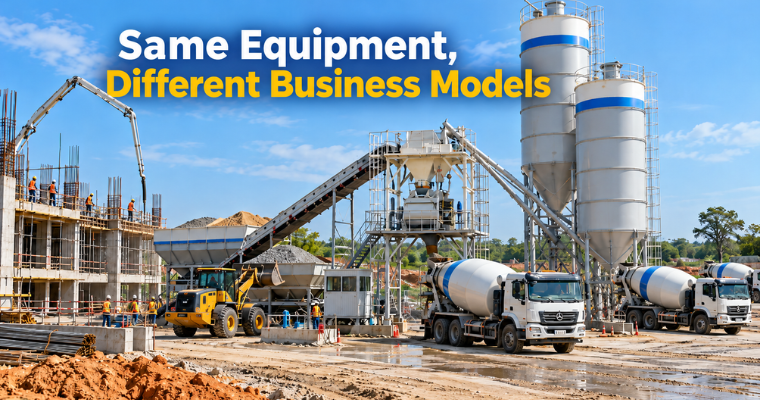
Same Equipment, Different Business Models
It helps to think of concrete batching plant as the noun describing the product, and RMC plant as one specific way that product gets used. A manufacturer builds and sells concrete batching plants. A buyer who deploys one to serve their own highway or building project is running a captive batching operation. A buyer who deploys the identical model to sell concrete commercially is running an RMC plant. The steel, the PLC, the mixer, and the weighing system inside the plant do not change based on which label applies; what changes is the buyer’s business model around it.
Which Term Should Guide Your Purchase Decision
For a buyer, the practical question is not which term is technically correct, but which usage pattern matches your business, because that determines the specification you should prioritize. Two buyers can request quotations for what they each call an RMC plant and end up needing meaningfully different equipment once their actual operating model is laid out.
- If you plan to sell concrete commercially to multiple builders, prioritize higher daily throughput, fast mix design switching, and a location with strong delivery access, typically favoring an inline configuration.
- If you are serving a single captive project, prioritize a configuration that matches the project’s duration and site space, which often favors a compact or mobile plant that avoids unnecessary foundation work.
- If you supply both a captive project and external customers, plan capacity around your combined peak demand rather than either use case alone.
A Quick Test to Identify What You Are Actually Evaluating
If you are unsure which framing applies to your purchase, three questions usually settle it. Will the concrete produced be sold to external buyers, or consumed entirely on one project? Will the plant stay at one location for years, or relocate once a specific project ends? Will mix designs change frequently across a single day, or stay fixed for the project’s duration?
- External buyers, long term fixed location, frequent mix design switching: you are evaluating a commercial RMC plant, prioritize throughput and mix flexibility.
- Single project, temporary location, narrow mix design set: you are evaluating a captive concrete batching plant, prioritize configuration matched to project length.
- A mix of both: size the plant for combined peak demand and prioritize a model with headroom to scale.
Apollo Inffratech’s Range Fits Both Models
Apollo Inffratech manufactures the ATP series across both inline and compact configurations specifically because buyers arrive with both framings in mind. Inline models suit commercial RMC operators who need sustained daily output and multiple mix designs, while compact models suit contractors running a captive plant for a single infrastructure project without the time or need for permanent foundation work.
For businesses that also handle site paving or need equipment for smaller, harder to reach pours, Apollo Inffratech’s slip form pavers and self loading concrete mixers complement the ATP range, giving buyers a single manufacturer relationship across both commercial RMC supply and project specific concrete needs. This matters in practice when a business grows from a single captive project into a broader RMC supply operation, since the same manufacturer relationship, service network, and spare parts pipeline carry over rather than requiring a fresh vendor evaluation each time the business model shifts.
Conclusion
RMC plant and concrete batching plant are not two competing products, they are two lenses on the same equipment: one describing the machine, the other describing the business built around it. Once that distinction is clear, plant selection becomes a question of matching capacity, mix design flexibility, and configuration to how you actually intend to use the plant, rather than getting stuck on terminology.
Whether your project calls it an RMC plant or a concrete batching plant, Apollo Inffratech’s ATP series is built to serve both the commercial supplier and the captive site operator from the same product line, backed by nationwide installation and service support.
Frequently Asked Questions
RMC Plant vs Concrete Batching Plant: What Is the Actual Difference?
Is an RMC plant the same machine as a concrete batching plant?
In almost all practical cases, yes. Concrete batching plant describes the equipment, while RMC plant describes that equipment being operated as a commercial ready mix concrete supply business. The core components, weighing system, mixer, and control cabin are the same.
Do I need a different plant if I plan to sell concrete commercially rather than use it on my own project?
Not necessarily a different plant model, but you should prioritize different specifications. Commercial RMC supply generally benefits from higher throughput and fast mix design switching, which usually points toward an inline configuration, while a captive project plant can often be right sized to the project itself.
Why do tenders and government contracts sometimes use both terms in the same document?
Because the equipment classification under IS 4925 refers to batching and mixing plants generically, while the commercial supply arrangement is described using RMC terminology. Both terms can appear in the same tender without contradiction.
Can one plant serve both a captive project and external RMC customers?
Yes, this is common in practice. The plant should be sized for combined peak demand across both uses, and mix design management becomes more important since the plant will switch between project specific and customer specific requirements more frequently.
Does Apollo Inffratech sell plants specifically labeled as RMC plants?
Apollo Inffratech manufactures the ATP series of concrete batching plants in inline and compact configurations, which buyers deploy as RMC plants, captive site plants, or both, depending on their business model.
Which configuration is better for a new commercial RMC business?
Most new commercial RMC operators start with an inline plant in the 45 to 75 cubic meter per hour range, which balances daily throughput with a manageable capital investment, though the right starting point depends on the delivery radius and customer base you expect to serve.
Share At:




Listen to the Audio Version
Table of Contents